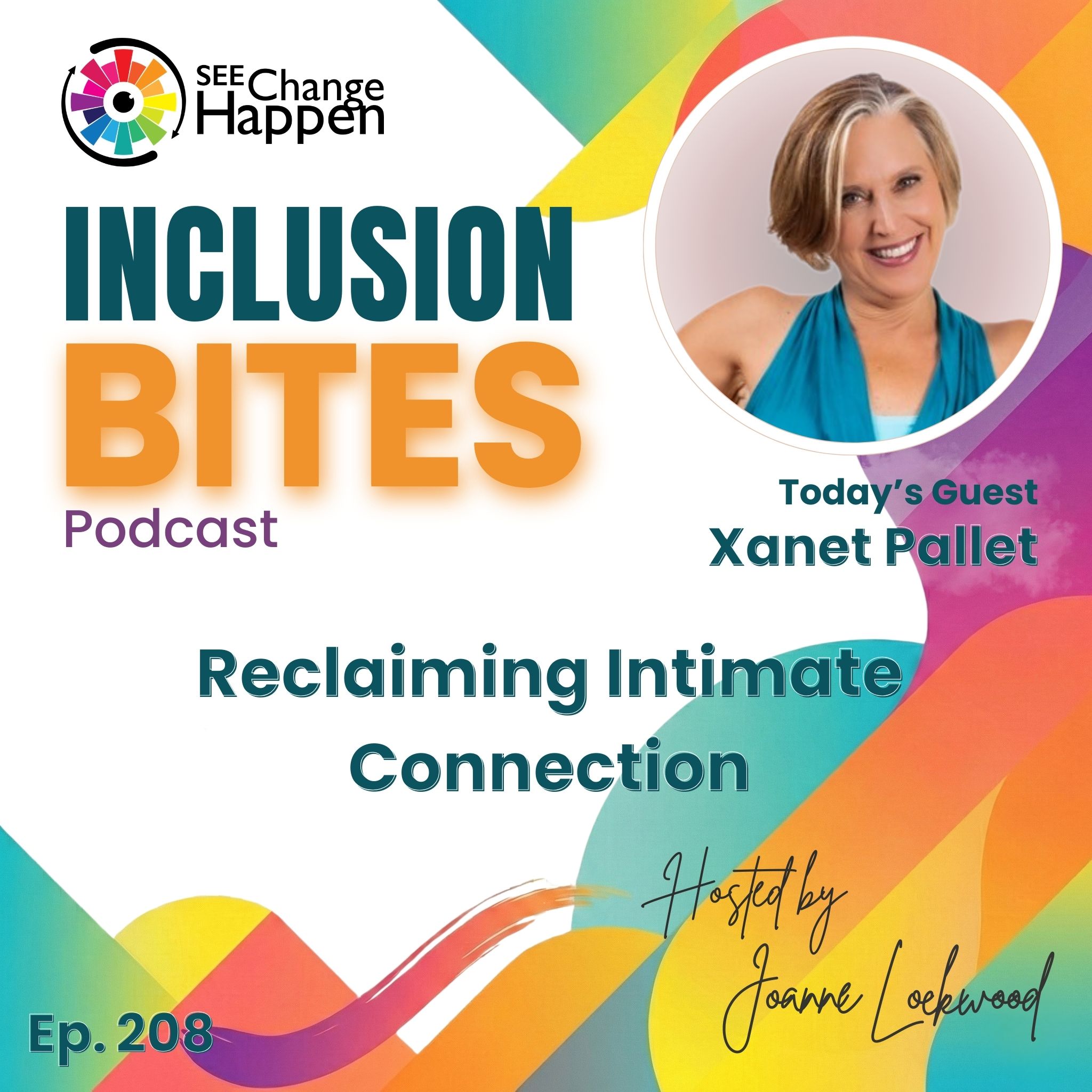
Xanet Pailet explores the complexities of rekindling intimacy, the significance of open communication, and the nuanced ways couples can rediscover connection and desire across the evolving landscape of long-term relationships.
In this episode of Inclusion Bites, Joanne Lockwood speaks with Xanet Pailet about lived experience identity.
Welcome to Inclusion Bites, your sanctuaryfor bold conversations that spark change. I'm Joanne Lockwood,your guide on this journey of exploration into the heart ofinclusion, belonging and societal transformation.Ever wondered what it truly takes to create a world? Remember, everyonenot only belongs, but thrives. You're not alone.Join me as we uncover the unseen, challengethe status quo and share storeys that resonatedeep within. Ready to dive in? Whether you'resipping your morning coffee or winding down after a long day, let'sconnect, reflect and inspire action together.Don't forget, you can be part of the conversation too. Reach outto [email protected]to share your insights or to join me on the show.So adjust your earbuds and settle in. It's time toignite the spark of inclusion with Inclusion Bites.And today is episode 208 with the titleReclaiming Intimate Connection. And I have the absolutehonour and privilege to welcome Xanet Pailet. Xanet is anationally recognised sex and intimacy educator, coach, bestselling author and retreat leader who helps committed couplesrepair disconnection and rediscover emotionaland sexual intimacy after years of struggle. When I askedShanae to describe her superpower, she said that it is her abilityto guide couples through shame and silence into honest,embodied conversations that restore safety, desireand deep connection. Hello, Xanet. Welcome to the show.
Xanet Pailetguest
Thank you, Jo. I am super excited to be here and have thisconversation with you and help your audience learn how tohave a better sex life and improve it.
Joanne Lockwoodhost
When your email came in with your blurb for the, for the show, I readit and thought, oh, this sounds interesting. Sex, Sex and intimacy educator.I thought, well, as a, as a, as a, as a 60 year old, I've,I've had my plenty of, plenty of life to have sexand it be intimate. So it'd be interesting to see where we go with this.Beautiful. So you're, you're based in the States somewhere, is it?
Xanet Pailetguest
I am, yes. I'm in the States. I'm in Asheville, North Carolina.Western North Carolina, in the mountains. We just snowed here a little bitlast night. Oh, wow. Wow. Because I always think of the
Joanne Lockwoodhost
Carolinas as being sort of the south and hot and sticky. Yeah,When I was there in what, 93, it was very hot andsticky. So you've got snow and mountains? Well,
Xanet Pailetguest
yeah. And in the winter, most of North Carolinagets colder anyway. Like, you know, people think it's going to bewarm here, but it's not. It's, you know, even by the beach. It's probablydown in the. Maybe freeze right here. It's. I don't know, in the 20s.
Joanne Lockwoodhost
I was chatting to another guest who is from Atlanta in Georgia, which is probablya neighbour, isn't it? Ish. Yeah. Like five hours away. Georgia.It was saying they were. They were saying it was cold. Yeah. Back last November.So you were having quite. Quite a cold snap, if you like.Disproportionate. Yes, yes, yes, yes, that is true. But,
Xanet Pailetguest
you know, we've got our warm coats and our fireplaces andUgg boots. It's all good. Oh, yeah, we've got to have
Joanne Lockwoodhost
our Ugg boots. We definitely gotta have our Ugg boots as well. Exactly.It's not really cold enough here for too much, but, yeah, we're more of awet and windy sort of part of the country. So. Yeah. Miserabledamp. Yeah, I can handle snow, I can handle a bitof ice, but, yeah, damp. Yeah. That's kind of hard too, the damp. The.
Xanet Pailetguest
Yeah. So you said in your notes that you put through
Joanne Lockwoodhost
that you yourself had experienceda 26 year sexless marriage andyou obviously had an epiphany. You had some moment in that time thattriggered you into doing something about that. So tell me a bit about that.
Xanet Pailetguest
Yeah, I mean, I was married for 26 yearsand that marriage was primarily sexless probablyfor 20 years, which is actuallyless uncommon than you would think. Right. Like, there's. There's a lot of couples thatare actually living in sexless marriages. And minewas really related to a lot ofmy own trauma growing up in childhood. Notsexual abuse trauma, but shame trauma, which is athing, and some medical trauma, which is also a thing. So it justmade sex uncomfortable and painful and my body was justreally, really shut down. And becausewe were super young, I was 24 when I got married. I justgraduated law school. We really didn't have skills,knowledge, information, the ability to be able to process this,to talk about it, to solve it, to do anything about it other than fightabout it and then just stop it because we had to stop the fightingand be parents. And so it just went on, you know, for 20years. And it for me was like, oh, you know, doesn't feel goodanyway, want to do this. Like, it just. It made no sense to me thatpeople wanted to have sex ever. Just didn't. I know, butit's true. And so, you know, like, what do we do? Like, we take all
Xanet Pailetguest
of that sexual energy which we have, like, poured it intomy kids and my business and my hobbies andmy side businesses and allowed the relationship towither because that's what happens a lot of the timeswhen there's bad communication, you're feeling disconnected from yourpartner, there's a big issue you can't talk about. And intimacy just likefades over a period of timeuntil we found ourselves living separate lives, livingin separate bedrooms, even while our kids were growing up. So, yeah,it was a challenging in some ways. It didn't feelchallenging at the time because I was so busy with other stuff.But looking back on it, it's like, yeah, that was. There was a lot ofgrief that happened of the. Not so much the sex, but the lackof closeness, the lack of feeling emotionally supported and emotionallyconnected. Does sex really matter in a relationship?Ah, so interesting. I just posted on Facebook aquestion. I literally posted that question like you can. And it was like,you can have. You can have sex without love, but in a long termrelationship, can you have love? Can you. You can have. Sorry,you can have sex without love, but in a long time relationship, can youhave love without sex? And I got a lot of feedback and a lot ofcomments on that question that I posed. And it was reallyfascinating to me to get to hear what people had to say. Sowhat I heard from a lot of people, and mind you, a lot ofthese people who are responding to my Facebook posts are already pretty sexpositive and a whole bunch of them are already in like openrelationships. So it's not really apples to apples,right? But you know, what I heardvery, very frequently was like, yes, you can. You know, likethat does happen over time. Things do change. And it's, and it's,you know, and I get that. And I always question whetherthat's happening with consent, whether it's happening because conversationsaren't happening. And actually one partner wants sex and theother partner has maybe a lower desire.So, you know, it's actually a great question. So clearly there's a lot of couples
Xanet Pailetguest
that are together who aren't having sex, right?The question that I always ask is like, is thatconsensual? Have you guys had a conversation anddecided like, yes, you know, we're in a new stage of lifeand we just don't want to have sex anymore. We just want tocuddle maybe, and that's just what we want, oris it that one person is holding a lot of resentment because her sexual needsaren't being met or, you know, as is often the case,is this really about, we're not having sex because there's otherrelationship issues going on underneath that. And we're feelingemotionally disconnected. And because we're feeling emotionally disconnected and there's a lot ofresentment and anger, we don't really want to have sex with each other. Right.So there's, there's a lot of different ways that you can skin that cat, ifyou will. It's a great question. I was super curious about how people answered it.
Joanne Lockwoodhost
I've. I've got loads of things firing up off in my head right now. Sohow, how, how would you describe sex?I mean, because sex is a spectrum. It is. Andit doesn't have to be penetrative. There are other waysof. Yeah. So how would you describe sex? I think that's. That's a great. That's
Xanet Pailetguest
a great question. Right. And I didn't, I didn't buy that. But, you know,typically, I think when people think about sex, they think about penis andvagina, which we call in the sex therapy world, pivotsex. Right. I don't define it that way. I think that's one of thechallenges that a lot of couples have in their relationship is they'reso oriented towards penetrative sex, andthey're so oriented towards goals andorgasms that they lose out on a lot of other opportunities.So, like, I define sex as a very,you know, sort of wide spectrum, just like you said,right? Anything from, like having a makeout session, like afruit first base makeout session, to penetrative sex. Right. Andanything in between. So if you can, you know, open up the definitionof sex, then there's a lot of ways to be able to connect with yourpartner erotically that don't have to involve.That don't necessarily have to involve penetration. That'shelpful for couples to understand that. But they also have to shift theirmind, right? There has to be a paradigm shift aroundwhat sex is and, you know, what it is now and what itcould potentially be. I think back to my
Joanne Lockwoodhost
school days, you know, behind the bicycle sheds, you know,going for walks in the woods. And I remember havingseveral girlfriends at the time who we wouldcertainly not go all the way. This was not a meatloafbat out of hell. I've got to know right now, will you love me foreverType conversation. We were probably first base, second base,groping, fondling, probably achievingorgasm, but not with anyPIV, if you want using the phrase you use.And I'm pretty sure at the time we thought that was pretty risky.We didn't feel that we were holding back. We just Respected each other enough tosay we don't want to go any further than that. And even in couples nowcan still go a long way without actually having penetrative sex.
Xanet Pailetguest
Totally. And it's a good thing to do.
Joanne Lockwoodhost
Yeah. And also justputting a sort of multidimensional spin on this. You know, we talk about this inheteronormative terms. Not everybody has oneof each in a couple. Sometimes you don't have a penis, you don't have avagina in a couple. PIV isnot the only way of. Totally of being intimate, is it? Yeah, yeah, yeah,
Xanet Pailetguest
definitely. And. Yeah, well, definitely. And non heteronormative. Right.There's a lot of different ways to be intimate, but yeah, it'sdefinitely not, you know, it can vary from, youknow, like I said, from having a makeout session toeven just sexting with each other or, you know, talking abouta fantasy like that can be a huge turn on for a couple.They don't have to do anything about it, but they can just talk about it.Right. So the more we can open up the definition of sex, themore ability, hopefully couples will have to be able tohave more sexual interaction with each other. So what
Joanne Lockwoodhost
we're saying here then is that the. The term sexis not one thing, is it? Is it? Or is there acommonality? Is it to. To put a phrase,something that gets your juices flowing in some way? Yeah, that's how I
Xanet Pailetguest
define it. Like anything that creates erotic energy is sex.That's it. That's my definition. That's a very, very broad definition,but I think it's a definition that opens up a lot more possibilitiesfor people to be able to interact with their partner sexuallywithout having all of the pressure that comes with, youknow, genital focus Sex? Yeah. So
Joanne Lockwoodhost
generating that. Generating that intimacy in however you do that,and that can be just through touch, through making out. Itcould be just beholding and hugging each other and just being with each other andfeeling that energy. Right. Without having to go all the way,whatever that all the way means. Exactly. Not everybody can.Without blue pills and Viagra, some people can't achieve that. Some people havemenopause, their vagina is not capable of receiving anymorefor various reasons. So, yeah, a whole host of reasons medically, why it may notbe practical as well. That's absolutely true. Yeah. So how did.I'm assuming that when you. Using yourself as an example, as you. Asyou put yourself on the line here, was it somethingyou drifted into and nobody noticed the slide until itGot too far. You had childrenand there's always obviously a pause whenyou're raising the children. You've got some stress going on, you're trying to work,look after the kids. All this other thing, you end up with tension and argumentsand debate. As you talked about, you fall out of love a bit, you neverquite reclaim that. Is it, is that typically a pattern? I don't know that
Xanet Pailetguest
my pattern withstander is like my patternI don't think is typical because of all of the pain that I hadwith sex. So it was just like, I don't want to do this, my bodyhurts. This isn't fun. You know, you're not getting off, I'm not gettingoff. We're. I'm crying, you're frustrated, likescrew this, right? So I don't know that I'm typical. But what istypical, right? And take me out of the, out of the equation forthe moment. I think what is typical is, yeah, ofcourse, you know, it does tend to happen and it doestend to fade, often slowly, before you know it,right. Certainly when you have children. Children screw up people's sexlives, we all know that, right? That's just an absolute reality.It makes it so much harder to find, to connect. Like it'sjust, you know, you never know when they're going to run into the bedroom, right?Like it is a problem. And even as they get older, like I was justworking with a couple the other day and they're like, well, we love our 13year old daughter, but like she wants to like come in at 10 o' clockat night and like, you know, shoot the shit with her and it's great, welove that. But that really screws up our sex life because we don't know whenthat's going to happen, right? So it's not like once they're past 10,things actually change. So that does make it challenging.And you know, you really have to, to make it a priority.
Xanet Pailetguest
But I do think that, you know,and this is, this is kind of what my Facebook post proved, right, isthat like it does fade slowly over timeand some of this is, you know, some level of it is anatural. Like things are going to change when you're in a long term relationship,right? Unless you really, it's important to you and you really make apriority to keep things interesting and new and different andexperiment because people start getting bored and a lotof times when you start getting bored, you know, sex is only okaythen maybe I'd rather be cooking, right? Likeit Just doesn't become as important, as much of a prioritywhen it just doesn't feel that good or if it's only okay or it's startingto get boring. And, and I think that's part of the reasonthat, that sex starts fadingover time. We're just doing the same thing over and over again. I can justpull up my vibrator and have an orgasm just as quick as you can getme that. You know what I'm saying? And that, that doesn't actually hitthe desires that we want. Like it doesn't hit our turn ons. And I thinkthat's where a lot of couples get stuck. They, they get in thisrote place. It's not really hitting their eroticdesires and their erotic turn ons. And so it just becomes, at best,at worst, it's like, I'm going to do it to please you because I don'twant to lose you. And then it becomes obligation sex.And then often that builds up, you know, some resentment.And so I don't really want to do that. I don't want to feel likeI'm having obligation sex. So it just, it stops.And you know, does stress get in the way? Like, let's take kids outof the equation, you know, financial stress,you know, familial stress. Like all of the things,all of the ways in which life is so stressful, especially now.Right. Especially in the United States right now.It really makes people lose their libido. They're justlike, you know, that is one of the biggest libido killers is stress.And I think a lot of people are feeling a lot of stress in theirbodies. Yeah. The world is not a, a safe
Joanne Lockwoodhost
place these days. Isn't it not a safe place these days? We're closer to nuclearwar than we've been since jfk. Yeah,
Xanet Pailetguest
absolutely. It's not Cuban. Missing class. Yeah, we're all,
Joanne Lockwoodhost
we're all feeling it. Is this truewhat Bert say when couples are in thesesexless marriages, Sexless relationships, sexless,whatever. However you want to describe the coupling, one of themcan be jolted into another, into a sexy based relationship withsomebody else randomly. You know, so I have an affair, flirting, sexting, glanceat the bar, quick drink, all of a sudden something happens. Sois that, does that kind of mean that inherently we're allwired to go, I can do this again. But it needs that,that difference, that trigger, that, that spark, those, those dopaminechemicals floating around in your head or something kicking off. So we've all got thatpotential to rekindle it with somebody else.
Xanet Pailetguest
Yeah. Trying to rekindle it together. Yeah. I mean, of course,I think that's one of the reasons, the biggest reasons that couplesseparate. Right. Is they're not having sex. Right. That is a hugepain point in a lot of relationships. Orsomebody goes outside of the marriage because they're not having sex in the marriageand then, you know, they go outside of the marriage.And yes. I mean, there is theabsolute reality that it is very, very hard to reclaim thatnew relationship energy in the context ofa long term relationship because it's very, very specificto that period of time when you first meet somebody. Those first sixto 18 months. Right. And the dopamine hormones are just surgingthrough your body, which is basically just mother Nature's, youknow, imprint on, want you to procreate. Really what's happening, Right.Even if you're 50 or 60 years old, it doesn't matter. You know,
Joanne Lockwoodhost
you're going at it like bunnies. You're going at it like bunnies, right? Exactly. Because
Xanet Pailetguest
of that new relationship energy. And that new relationship energynaturally fades after 18 months at the most. Right.Couples that have been able to maintain that level ofconnection that I've seen and, and worked withor have talked to have experienced are really couples whomake it a priority,understand that they need to change things up in their relationship. Like, theycan't do the same thing over and over again. They need to becurious, they need to explore, they need to try new things.They, you know, and, and not just in their sex life, by the way.Right. Like in other aspects of their life. Like, we do have research thatshows it's fascinating, which, but it shows that couples thatdo a lot of different interesting things all the time, like, oh, one day we'regoing to go to the museum and the next day we're going to take acooking class and, you know, whatever, have a better sex.Because they're more, you know, they're more focusedon doing new things and changing things up. And just doing those thingsmakes it more exciting and interesting to be with your partner becauseyou're experiencing new things with them all their time. And you get to look atthem and you're like, oh, look at you. Like you're cooking in the kitchen. I'venever seen you do pastry before. Right. And you kind of fall in love withthem again. So, you know, that is one of the, that's one ofthe, that's one of the things that I've really learnedis how important it Is in the context of a long termrelationship, to find time outside of the bedroom to do new, funand interesting things with your partner, to be explored, to adventurous, totry new things. Because it does keep that energy going and thenthat can flow over to the bedroom as well. Again, you're talking about things that
Joanne Lockwoodhost
are flowing through my head. It must be very. One of thechallenges must be trying to synchronise your libido. WhereI'm coming to bed late or I'm going to bed early, you're going to bedlate, you want to read your book, I want to finish watching the telepathy. Justfinish off some work and you say, I'll do the washing up, take the dogout and you just go, yeah. Or if one person is feeling a bit hornyearlier and the other person's in this other zone, it's trying to synchronise thoselibido moments, isn't it? Yeah. And you know, and that
Xanet Pailetguest
is often a challenge in long term relationships.You know, I hear that all the time. I'm a morning person, he's a nightperson or she's a night person.And then that is a challenge. Right. But it is,it is all the answer to that iscommunication. The answer to everything is communication. Can we find a
Xanet Pailetguest
compromise? Can we figure out a time, can we put something on the calendar,you know, at a time of day that actually works for bothof us? Can we be very conscious around ourdesire to have sexy time or to have sex that night orthat morning or whatever? And I know that people are like, oh, planning. Itis like, it takes the spontaneity out, but it's like, you know,yeah, the spontaneity has to come out at times. Right.Planning it actually allows your brain, which is our biggestorgan during sex, to be able to start to get on board.Yeah, we have, you know, sexy time plan fortonight. Let me start thinking about that. What do I want to do? What doI want my body to feel like? You know, maybe for, for some peopleit's like, oh, maybe I need to masturbate a little bit before. Right.Like really thinking about what your body needs to start todo, what you can do inside of you to, you know,pull up some of your desire. But thatdoes take commitment and it takes a level ofconsciousness and awareness of what your arousal pathwayis and really making sex a priority in therelationship. And that is a huge, huge difference. Whencouples make sex a priority in their relationship, then they starthaving a lot more enjoyable sex. If you're having an affair
Joanne Lockwoodhost
and you're having to sneak around and do things, thenit's often not spontaneous anyway, because what you're thinking is, oh, I've got to booka hotel room, I've got to sneak out the house, I've got to make allthis cover storey. It's surreptitious. Sex isn't just. Isn'toften spontaneous. Maybe if you're picking something or hooking up at a bar, maybe itis. But once you get into. Into week two, you're nowsneaking around. You're totally planning as. You're totally planning as
Xanet Pailetguest
well. But I think the difference is that for some people, the riskis sexy. Right. For a lot of people, like the,you know, there's something about. It's like, I might get caught. Right. Like there's.
Xanet Pailetguest
There's some sort of erotic charge potentially under, youknow, underneath that. For some people, that's part of, you know,what turns them on is being in a risky situation. Right. Whichyou can totally translate to your partner. Right. Well, if, if, ifin fact, you know, being in a little bit of a risky situation is partof my turn on. Well, what if, like, youknow, we try to have sex in an elevator or, you know, we go outto dinner and I put my hand under her skirt orwhatever? Right. Like, there are ways to do that. In the contextof the relationship, it's understanding what your turn on isthat actually allows that to happen. Yeah. No, I'm
Joanne Lockwoodhost
with you. In my relationships over the years, I've definitelytickled those boxes. You know, there are. There are other opportunities. And when you. Whenwe broaden that definition of what sex means, and it's not just thatfinal getting down and dirty and that. Yeah, that groaning andgrunting at the end. It's. It's all the things that go into that. Yeah. Andit's. Sometimes it's just touch, sometimes it's just connectionbeing there. My wife and I, we often flirt a bit. We do a lotof stately homes, we go and visit a lot of old properties in the UKand sometimes we work out that when we're walking around these big old homes andwe're the only person in the room or we're. There's a big door, we sortof sneak behind the door and sort of go a bit of a. Bit ofa cuddle or a bit of a Bit of a bum pinch or something andgo, no one saw that. Yeah. So we do a bit of that. I love
Xanet Pailetguest
that. Yeah. You could take the opportunities wherever you Are. And
Joanne Lockwoodhost
just even if we go to the cinema and sit there andsome popcorn. Yes, for sure.
Xanet Pailetguest
I love to hear that. Right. And I think that is one of thepieces that we, we miss in, in the long termrelationship is the flirting. When you first met, there was probably a lot offlirting happening, right? But again, that's something that kind ofgoes away. Because what is flirting? It's like, you know, you're trying toget somebody's attention, right? You're supposed toshow yourself off, whatever it is. But when you're in a long termrelationship, you don't need to have that person's attention. You've got that attention 247. Right. You know, rememberinghow much fun it was to flirt with your partner is important.Right. And again, that's part of building up,building up the desire and recognising thatyou've got to keep things like fresh and interesting and show yourpartner that you still think that they're attractive and sexy and that you want to,you know, be with them. Yeah, my wife does it to me and I do
Joanne Lockwoodhost
it to her from time to time where she'll say, why don't you have yourhair down today because you look much better with your hair down. Or how aboutwearing that dress? I haven't seen you wear that dress for ages. Or come on,don't wear your jeans again. Put something nice on or put a bit of makeupon. I go, okay. And it's really nice to know that she cares, she'sthinking about it and she wants to see me in a different light rather than,okay, I can dress up a bit. Come onthen. Yeah, you too, go on this. It's both a bit posh.We're only going shopping, but why not? Why can't we posh up for a bitof shopping, have a bit of fun or go to dinner or something?So those are little ways of just showing yourpartner the person you're intimate with, thatyou're thinking about them in that way as well, right? Absolutely. And
Xanet Pailetguest
I think that is important because what you're bringing upis we all want to feel desired. That issuper important. And when your partner tells you, oh,I love when you have that dress on or put your sexy underwear on,you know that there's some desire there, right. And that they're thinking about you andpaying attention to you. So that is, you know, an important pieceof maintaining a good sex life is showingfor each partner to show each other that they still desire that.Right. Whether that's physical touch, whether it's usingwords, whether it's sending a sexy text or whether it'stelling your partner to, you know, not wear panties. Night. Right. Allof that is showing desire. Bit wet and windy at the moment.
Joanne Lockwoodhost
I'd probably be safe. Safe with them onsome pantyhose as well. Yeah.Presumably. I'm guessing here,give me if I'm wrong, that you tend to get involved with couples whoalready have a desire to have a conversation. Peoplewho don't want to have a conversation probably don't get in contact with you. You'realready seeing people who want to. I guess the key thingto start this off is are we both agreed that we want todo something positive about this? Because if we can't agree onthat statement, there's no point in carrying on, is there? We might as well justsay, I never want sex again with you. I don't want sex again with you.Maybe that's the honest conversation. Maybe. Maybe that's the point where we say, actually weeither go into an open relationship or we part companyor we put up with that. Yeah, no, I think that's true. I mean, you
Xanet Pailetguest
know, couples who reach out to me are often at the endof their rope. Right. They're at a crossroads. You know, they're like,if we can't solve this, you know, we've been to therapists, we've been tosex therapists, but you're kind of. Janet, you're our last resort. If we can't.If we can't solve this, then either we're going to open the relationship up, whichis not generally, just in general, not who I seesometimes, occasionally. Or it's more like we're going to go our separate ways.Right. But they both have to be on the same wave wavelength. Right.They both have to want to change. They both have to want to work onthis. Otherwise nothing's. Nothing's going to happen. Right.But, you know, I mean, I think that a lot of couples,for a variety of different reasons. Right. Believe that marriage issacrosanct and they are committedto trying to fix their relationship.Certainly those are people who tend to show up in.In my office. Right. Andthey're, you know, they'll do anything. Right. You know, especiallyif there are children involved and. And they feel like it's stillfixable. Sometimes it's not. Right, Jo? Sometimes it's like you've gotten to apoint where the relationship is so toxic that the best thing to do is toseparate. And I'm very honest with people. If that's where we're at. But, butfor a lot of, a lot of people who, you know, have childrenin the picture and they, they're still like friends,right? If they're still friends, but they're not lovers anymore,there's a lot that can be done there, right? If they hateeach other, that's a lot harder to work through.
Joanne Lockwoodhost
Yeah, well, I suppose you don't have to like someone to have sex with someone,do you? You don't have to, is that what you said? Yeah. Youdon't have to. Oh, you don't? You don't. But
Xanet Pailetguest
typically, if there's a lot of fighting going onand it's a couple that has atremendous amount of high distress, couples is what we call them.They are not having sex because they are. Oneor both of them is feeling emotionally shut down. They're resentful, they'reangry. They have no desire to beable to open themselves up to their partner and do anything for their partner thatfeels good. So I mean, it is highly unusual that adistressed couple is having a very active sex life. You're more likely to want to
Joanne Lockwoodhost
put deadly nightshade into coffee, aren't you? I suppose at that point, right? Something like
Xanet Pailetguest
that. It's more likely that's gonna happen. That would spice it up a bit. Yeah,
Xanet Pailetguest
that would spice it. But I do wanna bring upa point. Cause I think it's an important point, right? You didn't ask the question,but I'm gonna answer it. So Ithink one of the places where couples really struggleis how do they know things aren't going right? Like,we're very well aware that things aren't going right. How do we startto have a conversation about this withoutopening up Pandora's box, right? Which peopleare very, very afraid of. Like if I open up Pandora's box, Ican't put all this back in. How do we have a conversation about it withoutthere being shame, without there being blame, without there being guilt,without me chasing my partner to the point that they're going to have an affair?And that I think is a really critical question that Ilook at a lot. And so I want to make a suggestionbecause I've actually tried to figure out how do I help couples get overthat first step? Because once they get over that first step, then the conversationcan open up and change can start to happen.So I have, I created a,an intimacy equation quiz which allowscouples. I think we might have talked about this in our pre call, which allowscouples to be able to identify what their intimacytype is. It's kind of like a personality test. Butthere's a lot of different intimacy types, which is important tounderstand. How do you communicate with your partner? Right. Some peopleare much more emotionally focused. Some people are more sensually, liketouch focused. Some people are more adventuresome. For some couples, trustand loyalty is really important. And so what I always recommend,and I'll say this to all of your listeners, is like to take this test,right. If you're the person who's like, oh, things are not going okay, but Idon't know how to have this conversation with my partner. Right. Sotake this test. You can find it at my website, which is how toimprove how to improve my love life. Com. It's like a three minute test. It's
Xanet Pailetguest
kind of cute. You'll get your results and you'll. Then you'll get some informationabout, you know, well, how do you interact? If this is your style, how doyou interact with other styles? What are that, are the, you know, thingsthat you need to be concerned about? Where do you work well together,have to be a little bit more aware and then go to yourpartner and say, like, hey, you know, I just took this kind ofinteresting quiz, this interesting test about like, what myintimacy style is. And it's, you know, X, Y and Z. And I'm kindof curious, like, what is yours? Would you want to take this test?Right. And then ideally that starts aconversation in sort of in a way thatis not very threatening to either partner.Right. And I do think that's really important, an importanttool for couples to have an awareness about, like,how do we start this without one of us saying we've got to go finda sex therapist? That can be very scary and offputting to a partner who is not onboard? Right. But something like this allowsthings to happen at a lower, slower kind of pace.It just starts about curiosity and conversation. Yeah. Because I
Joanne Lockwoodhost
would imagine that first step, there'spotentially blame in there. There's potentially a why. If I askyou why you don't want to do this. I do.You don't. Right. Because the why opens, asyou say, opens this Pandora's box totally. Suddenly all this stuff comes backwhere you don't do this and you don't do that. And it's so it's a.
Xanet Pailetguest
And it's scary then into a whole. New territory, aren't we? Right. And it's.For a lot of people, it's terrifying because I don't know what that answer isgoing to be. And I don't know what the consequences are going to be. What'sthe repercussions if we start having this conversation? Are we going to end up divorcingor is one of us going to go have an affair? Right. Which iswhy, like having this, this quiz, this tool, to be able tohave a gentle conversation from coming from a placeof curiosity rather than blameis so important. To be able tostart to fix things, if you will. Yeah, I think that's
Joanne Lockwoodhost
good. As you say, it's more like a magazine quiz and that you sit thereand you take a tick back pages and go, oh look, my sex style isthis. It might just be that you both sit there and look at each otherand go, well, neither of us like initiating. We both want to have the otherperson initiate. And because neither of us do, we wait for the other one. Itnever ever happens. You get to the point where you've got your couples or throuples.Presumably you work with a multitude of people here. Yeah, I've
Xanet Pailetguest
never worked with a throuple as a. I'd love to, but I neverhave. I've got a couple of friends who are in throuple relationships and
Joanne Lockwoodhost
I've never got any further than just going, okay, if it works for you. I'venever, never, never really done a Q and A about it. But yeah, it's. Iguess in those dynamics that means you've goteither more outlets to have different sort of relationship and it doesn't. They'renot necessarily orgies, are they throuples? They could be one to one relationships within acertain couple. I think if you're in a throuple. Right. You know, by,
Xanet Pailetguest
by definition you are probably in a placewhere there's a lot of good communication happening around yoursex life because you wouldn't be there, you couldn't be there if that wasn't happening.Right. Like that is, you know, one of the strengths of thepoly open relationship community is people tend to have very, very goodcommunication skills and they're very transparent about what'shappening. Which is why, you know, I wouldn't expect to see a throuplenecessarily show up in my office for what I work on.I could see them throwing. Showing up in other offices. Yeah,
Joanne Lockwoodhost
I was just also just thinking there that I would imagine that there are somepeople who have a fantasy or a desirethat they feel is too much,either embarrassed to share it or that they think it would.We talked about in the beginning, shame, all these sort of things going On. IfI say this would turn me on, they're scared the other person might go, oh,wow, that's a bit. Not sure about that. Oh, it sounds a bit icky tome. But that's really where their head is. You know, they went through the mechanicalstuff when they were having children. And, you know, you have to do oneof these and one of these and one of these to get. To get children.But when you're after that, you think, actually, what I really desire is this,but I don't know how to approach that. Does your intimacysurvey allow that to come out, or is that still a. That's not. Like,
Xanet Pailetguest
that would not be in this particular quiz.Because I think that would be, you know, I mean, for me, fromwhere I'm at, I think that would cause a lot of potentialconflict in a couple, and then there's nobody there to help facilitatethat conflict. Right. And so I don't want to set people upwhere they have to, you know, go find a therapist, becauseall of a sudden they're fighting because, you. Know, these boxes that said, but it
Joanne Lockwoodhost
has a fantasy. Yes, yes. Right. I mean, maybe that would be a better business
Xanet Pailetguest
model, but that's not how I. But I will say that that happens.That shows up all the time. In fact, we always talk about that.I probe about that. We explore that in mywork that I do with couples, because very often,that is one of the pieces where there is a lot of shame.
Xanet Pailetguest
And 99% of the time, like,at least what the fantasy that they have is nothing crazy, right?But they've just, like, are so afraid that their partner thinks that they'regonna be too big or too much or too we. And that all just comesfrom, like, you know, a shame. For me, that just comes from,like, a shame place. Right? But I really do help couplesbe able to be in a place where they can explore that with each otherand have a conversation about it. And underneath thefantasy is really what we call the core desires, which are theemotions that you want to have when you're having sex. So what is it that'sactually turning you on within that fantasy andunderstanding what that emotion is? Whatever it is, right.Then if you can't have that, if you can't accomplish that in. Inthat particular fantasy, because maybe it's a boundary for your partner, howelse can you get that emotion metin your sex life? That's very important. That is like, the difference
Xanet Pailetguest
between sex is only okay or it's good to sex isamazing. And I want to Keep on having it. Because that emotional need of mine,which goes back to a core wound as a child, is actually beingmet and satisfied. And that is the basis of thatturn on and that fantasy. So I really helpcouples, you know, I take them through some exercises and processes andconversations where we really pull that apart and really understandwhat's underneath and then how they can help each other meetthat need, that emotional need during sex. Verypowerful. So not every fantasy needs to manifest itself in
Joanne Lockwoodhost
reality, does it? Absolutely true. You could keep the fantasyas a sexting or a flirting or a sort of like, likeall that tension. You hint, you go, well, we're gonna be doing this. Wow.But the actual reality is it never gets to that point. You then break andgo vanilla if you like or whatever it may be. Yeah, I mean some fantasies
Xanet Pailetguest
are better. Leftist fantasies. Like I've had that experience, youknow, of like a fantasy that I thought I wanted and then we started doingit and I freaked out and I was like, yep, nope, that's not gonna work.That was all better left as a fantasy. Right. And that's okay.
Joanne Lockwoodhost
Sexy movies is perfect, isn't it? It's, it all always works out.The coupling happens easily. There's no kind of.
Xanet Pailetguest
And then there's fireworks. I'll be back. Fireworks every single time.Everybody has an orgasm simultaneously. So unrealistic.
Joanne Lockwoodhost
I know, I know. But yeah, so, so, so sometimes fantasies are better off just
Xanet Pailetguest
kept as fantasies. You could use it for your own turn on, for masturbating.Some people go into fantasy during sex. Like that's helpful for them.And if, if they do, I'm like, okay, that's fine. Like whatever you need toget you there is completely appropriateand acceptable. Right. So fantasy isn't cheating then?Not in my mind at all. But some people do feel that's cheating.That is one of the issues that will come upon a not infrequent basis. Like if I have a fantasy, itfeels like I'm cheating. And so it's my job to say, yeah, no, likeno fantasies turn ons. This is you soothing your childhood wounds. Let's reallytalk about this. Let's understand where this is coming from and whythis is a turn on for you and for your partner to understand that aswell. But you know, I, I don't see that ascheating at all. No, but I'm very open, I'm very sex positive.Like I have no judgement. Right. I mean, you know, you come into my office,you talk to me, you read my book, it's A judgement free zone, like ahundred percent. It is. You know, I don't judge anybody forwhat their desires are, whatever it is. Yeah, no,
Joanne Lockwoodhost
I can imagine. If you're, you're using some sort ofporn in your masturbation routine, then bydefinition that is not the part. Unless your partner's giving you the porn tolook at or to experience, it's generally somebody else in those images,whatever it may be. So if you can rationalise that as not cheating,then that's not cheating. But yeah, at the point you're being intimate, if you'reimagining the person you're being intimate with is actually somebody else, then that, that's whereit becomes a bit confusing, I guess. I think, you know, again, that's, you know,
Xanet Pailetguest
depending on where you are in your relationship and where you arein your level of communication. Do you want toshare that? Not everything has to be shared either. I'm very clear. I'm very clearwith people like, you know, you get to hold on to your own stuff.Right. And you don't have to share everything with yourpartner if it doesn't feel. I mean, I feel like the more disclosure youhave, the more connected you'll feel with your partner.But not everything has to be disclosed around, aroundfantasies. Is it, is it pretty evenly balanced between
Joanne Lockwoodhost
genders of couples where it's generally it'seither the male or the female. We're talking about heteronormative relationships herewhere typically both of them have anissue or is it often one sided? Is itafter childbirth? Is it stress? We seem to havelost Janae, so I'm going to hang on here in case she comes back.Fingers crossed. Fingers crossed. You'll reappear and we'll carry onwhere we were. That was weird. Yeah. You're back.
Xanet Pailetguest
Okay. Is that gonna. Because you gotta, you gotta go. So should we
Joanne Lockwoodhost
just. I do get, get to the close. Yes. Do you wanna,do you wanna give me like a finaltakeaway? Yeah, things, Things to think about and thenI'll, I'll go. So who are you? How do people get hold of you? Okay,
Xanet Pailetguest
great. I'll. Thank you. And. Yeah. How's that? Yeah, I think, you know,
Xanet Pailetguest
at the end of the day, what, whatunderlies all of having more intimacyand, and, and more connection with your partner isfirst good communication. And though we didn't really talk about thismuch emotional safety, which is a huge reasonwhy couples are feeling disconnected and are not having sexand don't feel like they can actually have a real conversation with eachOther because what they say might be used against them orweaponized and they've been shut down before. Right. Orcriticised. Like there's a million defence coping mechanisms that peopleuse. But those are the two most important to me. Those are thefoundational elements that and I focus on in mycoaching and my book around being able to createmore intimacy in a long term relationship. Tonight is
Joanne Lockwoodhost
been absolutely fascinating. I we could talk all day and I was in dangerof sharing too much of my own love. As we were going through that Ithought well I better not say that but let's not say that. Let me savethat for my own. But no, it's been absolutely fascinating. It's been really great. Howdo people get ahold of you and find out more? Yeah. So the best way
Xanet Pailetguest
to get hold of me to find out of my book is called the Sexand Intimacy Repair Kit and you can pre order it onAmazon and Jo will have the linkin the show notes. But the best way to get a hold of me andfind out about my programmes that I offer in my book is to go tothis website, howtoimprovemylovelife.com how toimprove my lovelife.com where you will also find the quizand then you'll get lots of information on also how to connect withme. Brilliant, brilliant. How to improvebylovelife.com that'll be in the show notes and
Joanne Lockwoodhost
I'm going to go and cheque it out in a minute and I think ifyou listen to this you should too and find that quiz because even if you'renot having trouble with new relationship, you might find something in the quiz that willspark something new and keep it, keep it, keep the juices flowing forlonger as they say. We love that. Xanet, thank you so much. Thanks
Xanet Pailetguest
Jo. As we bring this conversation to
Joanne Lockwoodhost
a close, I want to express my deepest gratitude toyou, our listener, for lending your ear and heartto the cause of inclusion. Today's discussion struck achord. Consider subscribing to Inclusion Bitesand become part of our ever growing community driving realchange. Share this journey with friends, family and colleagues. Let'samplify the voices that matter. Got thoughts,storeys or a vision to share? I'm all ears.Reach out to[email protected]and let's make your voice heard. Until next time, thisis Joanne Lockwood signing off with a promise to return withmore enriching narratives that challenge, inspire andunite us all. Here's to fostering a more inclusive world. Oneepisode at a time. Catch you on the next bite.
Redefining Sex and Intimacy in Long-Term RelationshipsThe Ebb and Flow of Desire: Communication and ConnectionShame, Fantasy, and the Role of Emotional Safety
In this episode, Jo Lockwood speaks with sex and intimacy educator Xanet Pailet about what it takes to restore intimacy in long-term relationships. The conversation focuses on how emotional disconnection, shame, stress, and routine can cause sex and closeness to fade over time, and why expanding the definition of sex beyond penetration can open up new possibilities for connection.
Xanet shares parts of her own experience of a long sexless marriage and explains how trauma, pain, and lack of communication contributed to that disconnect. She also offers a practical, sex-positive approach to helping couples talk about desire, fantasy, and changing needs without blame or judgment. A recurring theme is the importance of emotional safety: if people do not feel safe to speak honestly, intimacy is difficult to rebuild.
The episode also explores flirting, playfulness, novelty, and making time for connection outside the bedroom as ways to sustain desire in long-term partnerships. Xanet highlights her Intimacy Equation quiz as a tool for helping couples begin conversations more gently and identify their intimacy style. The overall message is that lasting intimacy depends on communication, curiosity, and a willingness to keep learning about one another.
“There was a lot of grief that happened of the. Not so much the sex, but the lack of closeness, the lack of feeling emotionally supported and emotionally connected.”
“Have you guys had a conversation and decided like, yes, you know, we're in a new stage of life and we just don't want to have sex anymore. We just want to cuddle maybe, and that's just what we want, or is it that one person is holding a lot of resentment because her sexual needs aren't being met or, you know, as is often the case, is this really about, we're not having sex because there's other relationship issues going on underneath that.”
“I can just pull up my vibrator and have an orgasm just as quick as you can get me that. You know what I'm saying? And that, that doesn't actually hit the desires that we want. Like it doesn't hit our turn ons. And I think that's where a lot of couples get stuck.”
“How do we start to have a conversation about this without opening up Pandora's box, right? Which people are very, very afraid of. Like if I open up Pandora's box, I can't put all this back in. How do we have a conversation about it without there being shame, without there being blame, without there being guilt, without me chasing my partner to the point that they're going to have an affair?”
“I just took this kind of interesting quiz, this interesting test about like, what my intimacy style is. And it's, you know, X, Y and Z. And I'm kind of curious, like, what is yours? Would you want to take this test? Right. And then ideally that starts a conversation in sort of in a way that is not very threatening to either partner.”
“And underneath the fantasy is really what we call the core desires, which are the emotions that you want to have when you're having sex. So what is it that's actually turning you on within that fantasy and understanding what that emotion is? Whatever it is, right. Then if you can't have that, if you can't accomplish that in. In that particular fantasy, because maybe it's a boundary for your partner, how else can you get that emotion met in your sex life? That's very important.”
“what underlies all of having more intimacy and, and, and more connection with your partner is first good communication. And though we didn't really talk about this much emotional safety, which is a huge reason why couples are feeling disconnected and are not having sex and don't feel like they can actually have a real conversation with each Other because what they say might be used against them or weaponized and they've been shut down before.”
The nuanced realities of sexless relationships and why they are more common than often assumed.
How sexual intimacy extends beyond penetrative acts and can be defined as any shared erotic energy between partners.
The impact of routine, stress, parenting, and mismatched libidos on relationship satisfaction and sexual connection.
The role of communication, conscious prioritisation, and emotional safety in reviving long-term desire and intimacy.
Strategies for approaching difficult conversations about sex and fantasy without assigning blame or shame.
The value of exploring and expressing fantasies—even if they remain unfulfilled—to better understand oneself and one’s partner.
Practical tools, including intimacy style quizzes, to spark curiosity and begin open dialogues that strengthen connection.
One thing to remember
The essence of this episode revolves around redefining intimacy in long-term relationships. True connection stems not merely from the act of sex but from emotional safety, open communication, and a shared understanding of desire. When couples broaden their concept of what constitutes intimacy—embracing everything from flirtation and touching to adventurous new experiences—they can keep emotional and erotic bonds alive, even as life’s stresses or physical limitations intervene.
Questions this episode helps answer
How does Xanet Pailet describe the spectrum of sex and intimacy, and why is it important to broaden the definition beyond penetrative acts?
In what ways might communication challenges contribute to the slow decline of intimacy within long-term relationships, as discussed by Xanet Pailet and Joanne Lockwood?
What role do life pressures—such as parenting, stress, or medical factors—play in the erosion of sexual and emotional connection?
According to the episode, why can “obligation sex” build resentment, and what signs might indicate a relationship is slipping into this pattern?
How does the concept of “new relationship energy” impact established couples, and what strategies did Xanet Pailet suggest for revitalising long-term relationships?
What are some effective ways couples can initiate honest yet non-threatening conversations about intimacy and unmet desires?
Explore topics
Ideas from this episode
Redefining Sex and Intimacy in Long-Term Relationships
Reflecting on my conversation with a renowned intimacy educator, I was struck by how narrow many of us have allowed our definition of sex to become. It’s all too common for couples to see penetrative sex as the only signifier of a healthy intimate life.
The Ebb and Flow of Desire: Communication and Connection
Another area we unpacked was the gradual fading of physical intimacy and emotional closeness that so often emerges in long-term relationships. Life pressures, work, raising children, and day-to-day stress all take their toll, making it easy for couples to drift into sexless marriages without even noticing the slow shift.
Shame, Fantasy, and the Role of Emotional Safety
Finally, we journeyed into the realm of fantasy and shame, and how these undercurrents often block true vulnerability between partners. Many have secret desires they’ve never dared to voice, fearful of judgement or rejection.
Learn
Frequently asked questions
FAQ: Reclaiming Intimate Connection — Insights from Inclusion Bites
What does it mean to "reclaim intimate connection" in a long-term relationship?
Reclaiming intimate connection means consciously restoring or enhancing the emotional and erotic bonds between partners that may have faded over time. It involves honest communication, redefining what sex and intimacy mean, and prioritising emotional safety and mutual desire for reconnection. As Xanet Pailet shares, many couples gradually lose physical and emotional intimacy due to life stages, miscommunication, or neglect. Reclaiming it requires recognising the slide, expressing needs without blame, and co-creating new ways to connect intimately (06:32)-(07:07).
---
Does sex really matter in a relationship?
Sex is an important facet for many couples, often intertwined with emotional closeness and overall relationship satisfaction. However, its significance and expression can vary. Xanet Pailet emphasises that while some can maintain love without sex—often with mutual agreement—others may experience resentment or disconnection if sexual needs are unmet, especially in the absence of open, consensual communication (06:35)-(08:48).
---
Is the definition of sex limited to penetration?
Absolutely not. The podcast underlines that sex encompasses a broad spectrum, including everything from making out and mutual touch to sharing fantasies or even sexting. Xanet Pailet advocates a definition centred on "anything that creates erotic energy," encouraging couples to explore diverse forms of intimacy beyond genital or penetrative acts. This approach is both inclusive and adaptable to different bodies, identities, and desires (09:05)-(13:01).
---
Why do couples drift into sexless or low-desire dynamics?
This often evolves gradually, influenced by stress, parenting, medical issues, lack of communication, or the monotony of routine. Over time, intimacy can disappear without deliberate effort to sustain it. Xanet Pailet notes that resentment, emotional withdrawal, and poorly synchronised libidos commonly contribute. Addressing these patterns calls for intentional prioritisation and adaptive strategies (14:12)-(17:47).
---
Can intimacy and sexual energy be rekindled after years of disconnection?
Yes, with conscious effort. Rekindling requires more than spontaneous sparks—it demands commitment, curiosity, communication, and often reimagining shared activities both in and out of the bedroom. Trying new things together, whether sexual or non-sexual, has been shown to energise relationships and renew attraction (20:32)-(21:31).
---
What is the impact of stress and life circumstances on libido?
Stress is cited as a major libido killer. Financial pressures, family issues, wider societal anxieties, and lack of emotional safety all suppress desire. Xanet Pailet and Joanne Lockwood discuss how external stressors often erode the emotional groundwork necessary for sexual intimacy (17:18)-(17:51).
---
Is planning sex less romantic than spontaneity?
While spontaneity is often romanticised, planning sex can help align mismatched libidos and foster anticipation. Scheduling "sexy time" enables partners to mentally and emotionally prepare, and can actually reignite desire and creativity. Planning does not preclude excitement—a “planned risk” or new adventure can bring its own thrill (22:04)-(23:43).
---
How can couples start difficult conversations about sex without creating conflict?
Starting with curiosity, not accusation, is key. Xanet Pailet recommends non-threatening approaches such as taking her "intimacy equation quiz" together, which helps illuminate individual intimacy styles and opens gentle dialogue. Initiating a discussion in this way avoids blame, fosters understanding, and can spark positive change without overwhelming either partner (33:12)-(34:52).
---
How important is emotional safety in maintaining intimacy?
Emotional safety is foundational for vulnerability, pleasure, and true intimacy. Partners must feel secure that expressing needs or desires will not result in criticism, rejection, or weaponisation of their feelings. Without emotional safety, communication stalls, resulting in defensive patterns that erode erotic and emotional bonds (45:32)-(46:14).
---
What role do fantasies play in a healthy sex life?
Fantasies are a normal and powerful part of sexuality—they can be a source of arousal, exploration, and even healing. Fantasies do not need to be enacted to benefit the relationship and sometimes are best left as imagination. When discussed openly, fantasies can help partners understand each other’s core desires, though not all must be shared or acted upon. Shame is lessened through acceptance and dialogue (40:49)-(43:01).
---
Is it “cheating” to have sexual fantasies about others or use erotic material?
No, not inherently. Xanet Pailet notes that many people experience guilt about fantasy, but private fantasies, self-pleasure, or erotic media use do not constitute infidelity unless it specifically violates mutually agreed boundaries within the relationship (43:12)-(44:32).
---
Can all relationships be “repaired,” or is separation sometimes the best outcome?
Not all relationships are salvageable. Some reach a level of toxicity, resentment, or incompatibility where separation is healthiest. However, many can find new connection when both partners are motivated, open to change, and willing to communicate honestly. Friendliness and goodwill increase the likelihood of repair; entrenched conflict makes it much harder (30:03)-(31:16).
---
Where can I find the intimacy quiz and further resources mentioned in the episode?
The intimacy quiz and details of programmes and the book The Sex and Intimacy Repair Kit can be found at howtoimprovemylovelife.com, as shared by Xanet Pailet (46:42)-(47:12).
---
For more conversations that challenge norms and inspire inclusive change, listen to further episodes at Inclusion Bites Podcast.
Share this episode
Heard something worth passing on? Send this conversation to someone who needs to hear it.