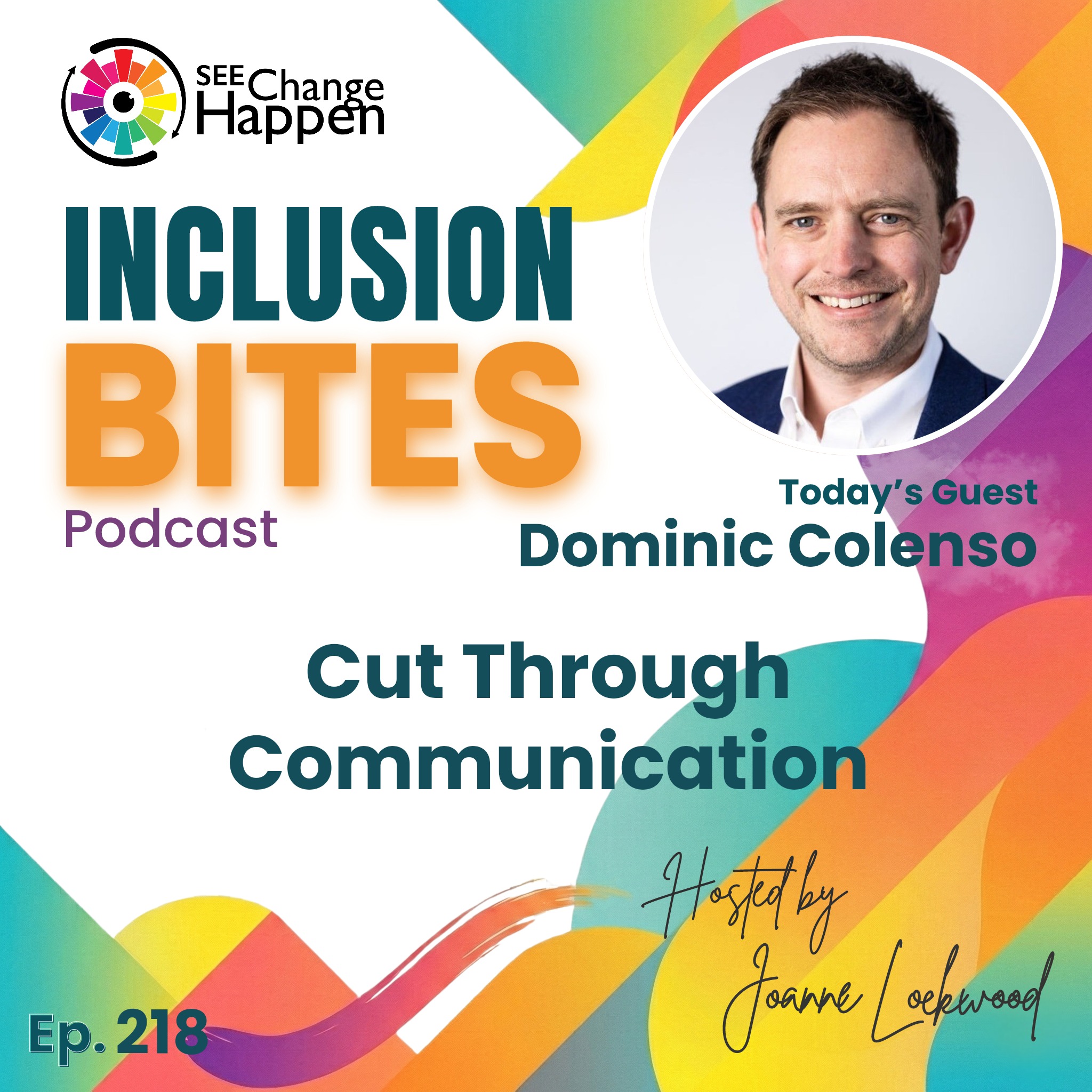
Joanne Lockwood welcomes Dominic Colenso, former actor turned communication coach, who shares his journey from starring in a Hollywood remake of Thunderbirds to helping leaders communicate with clarity. Dominic reveals insights on storytelling, career shifts, and the evolving demands of impactful communication in leadership.
In this energising episode of The Inclusion Bites Podcast, Joanne Lockwood is joined by Dominic Colenso for a profound exploration into “Cut Through Communication.” Together, they unravel the subtleties of how to communicate with clarity, adapting to different styles and personalities, and ensuring every voice is heard. Joanne shares the value of strong storytelling and directness, while Dominic draws on his unique journey from professional actor to communication coach, demonstrating how presence and vulnerability are essential in carving out authentic, inclusive conversation spaces that inspire genuine engagement and change.
“It's not like any other job, but ultimately it's show business and there is a real business element to it.”
Explore
Navigate this episode
Joanne Lockwoodhost
Welcome to Inclusion Bites, your sanctuary for boldconversations that spark change. I'm Joanne Lockwood, yourguide on this journey of exploration into the heart of inclusion,belonging and societaltransformation. Ever wondered what it truly takes to create aworld? Remember, everyone not only belongs, butthrives. You're not alone. Join me as we uncover the unseen,challenge the status quo and share stories that resonate deepwithin. Ready to dive in? Whether you're sipping your morningcoffee or winding down after a long day, let's connect, reflectand inspire action together. Don't forget, you can be part of theconversation too. Reach out to[email protected] to share your insights orto join me on the show. So adjust your earbuds and settlein. It's time to ignite the spark of inclusion with InclusionBites. And todayis episode 218 with the title Cut ThroughCommunication. And I have the absolute honour and privilege to welcome DominicColenso. Dominic is a speaker, author and coach,formerly a professional actor who now helps leaders and sales teamscommunicate with clarity and impact so that more people have a voiceand a voice that is truly heard. When I asked Dominic to describe hissuperpower, he said that it is storytelling and his fascination with theworld and the power to change it. Hello, Dominic, welcome tothe show.
Dominic Colensoguest
Hey, Jo, lovely to be here. Thanks so much for having me.
Joanne Lockwoodhost
Absolute pleasure. We met all probably six, seven years ago, didn't we, at aProfessional Speaking association conference? And I think I was sat next to you at dinner or something and
Dominic Colensoguest
yeah, I think we met in the bar and then we ended up having dinner togetherand. Yeah, it was great.
Joanne Lockwoodhost
Yeah, it was a fascinating evening. And then I. You told me the story about, you know,I mentioned in the bio just then about being a professional actor and that was like abig bomb penny drop, wasn't it? It was like. I guess you get a lot of people when youfirst tell them that story, which I hope you're going to tellnow.
Dominic Colensoguest
I think it's always kind of a great curiosityinducer. I think there's something about acting and the kind of world of showbizthat always makes people curious. I don't want to disappointyour leaders, but I do also think it's just a job and we can kind of discuss thata little bit later on. But you're absolutely right. I started my career as a professionalactor. I went to one of the kind of big method drama schools in theuk. Tom Hardy was in the year above me. It was all very kind ofintense. The nickname of the place was Trauma Centre. Should have been aclue. But I then was really blessed to getout of drama school and straight into professional actingwork. I did BBC period drama while I was still in my third year and then withinsix to nine months of leaving drama school I landed the role of Virgil Tracy in the Hollywoodremake of Thunderbird. And that was, if you forgive the pun, the kind of takeoff formy career.
Joanne Lockwoodhost
And maybe telling the story that they originally draft commissioned youfor three. For a series of three.
Dominic Colensoguest
Yeah, absolutely. It was a big deal. We, we were genuinelykind of slated to be the next bigthings. So we had a three movie deal. Everyone was sort ofhyping this thing up with the, the merchandise, the, the kind ofadvertising and everything was huge. We had busted doing the theme tune which at the time they wereprobably one of the biggest kind of boy bands in, in the UK and it was allexciting. So we as a, as a cast genuinely believed that we were going tobe in each other's pockets probably for the next 15years. Because these things have a kind of life of their ownnormally. Unfortunately, when, when we released the first film, the box
Dominic Colensoguest
office in the UK was great. The box office in Japan and in Europe wasgood but it just didn't make its money in the us. The, the Americans were a little bit kind ofconfused about it. It was a British puppet series so I don't think it hadtranslated ne necessarily over there. And the timing of the release was reallybad. We were released in the US against Spider Man 2 and Shrek 2 and they boughtthe release forward rather than an Easter release, it was a summer release andthat just meant that unfortunately it kind of sank a little bit without atrace. And about three or four weeks after the US launch got aslightly sheepish call from my agent to say yeah, unfortunately we're not going ahead back to
Joanne Lockwoodhost
the drawing board because you. It was also the time when thatwhole Marvel DC franchise, it was all those remakes, that was the thing,wasn't it? Everybody wanted those sort of movies.
Dominic Colensoguest
And I mean what I love about the film is that ithas actually really stood the test of time. So I now have a 12 year olddaughter and when she was sort of 56 she was absolutelyobsessed by it. And it wasn't. This sounds reallyegotistical. I didn't say, right darling, sit down and watch daddy in amovie. She was actually at my mother in law's house and it came on the TV andshe saw dad as A. As a superhero. And it was really interesting because she was reallyconfused at that age as to whether I had had a former life, you know, putting out fireson oil rigs. And so we kind of kept that going for. For a littlebit. But her and her friends and all of their kind of peer group justreally loved the film because it is a great feel good.
Joanne Lockwoodhost
It's a great. I remember seeing it at the cinema. I remember enjoying itimmensely.
Dominic Colensoguest
Yeah, yeah. I had a conversation with Jonathan Frakes,who was the director. He played Riker in Star Trek, but he's also directed a lot offilms. And I had a conversation with him a couple of years ago and he saidsomething that really kind of hit me. He said we were meant to grow oldtogether. And from his perspective, he was signed up for the wholefranchise and he really believed that we were going to be making these movies foryears and years and years.
Joanne Lockwoodhost
And the press tours and the. And all the.
Dominic Colensoguest
Yeah, exactly. All of thatcraziness.
Joanne Lockwoodhost
Franchise. You'd be having sort of spin offs.
Dominic Colensoguest
Exactly. And there'd be loads of, you know, dolls behind me with my face on it and different hairstylesand all of that sort of stuff. Yeah.
Joanne Lockwoodhost
I remember you saying something like there was a moment when you realised you talked about all these little toysand stuff. Was it you Weren't in the McDonald's Happy Meal, that was Spider manand you were in the Wendy's. Or was it something like that?
Dominic Colensoguest
Yeah, that was. That was a kind early warning sign as I look backon it was that when they came to. To do all of the merchandising, Ithink it was Shrek was Burger King, Spider-Man was McDonald'sand we had ended up in. It wasn'tWendy's. What was it? It was Wimpy. That wasit. It was Wimpy.
Joanne Lockwoodhost
Wimpy.
Dominic Colensoguest
There you go. Right. This is. This is probably. We don't quite have the position third division thatwe need right now. Yeah.
Joanne Lockwoodhost
But you. You've name dropped in the past. You know, you've done work with some very well known leadingthespians, you know, of the stage and yeah, you've mixed in that circle andit. I think you're right. From an outsider's perspective it all seems quitemagical and. And sort ofinspiring. But to you it was just a job. You just do what youdo.
Dominic Colensoguest
I mean, it's still really exciting. I mean I'd be ludicrousto. To downplay the kind of fantasy and the makebelieve. I remember like turning up at Pinewood Studios, which is whereThunderbirds was filmed. And a. Someone comes and picks you up in a massiveMercedes to take you there. And then they drop, drop you off and you kind ofpull up outside the studio and there's a runner waiting to escort youin. And you're walking down the corridor with all of these photos of famouspeople, you know, different Bond villains and amazing actors who haveworked there. And then you walk out onto the Soundstage and there's these
Dominic Colensoguest
sets that are just absolutely mind blowing. I mean, Tracy island had aswimming pool, so we were. We were in a big warehouse hangar, but we wereswimming in the. We were swimming in pool when we were on Thunderbird 5 and itwas getting blown up. You know, the gimbals moving, the whole thing's, youknow, explosions, smoke, sparks. So it's kind of like being in a themepark. When we shot the oil rig rescue scenes, wewere. We were in the backlot in a big, big watertank. I had like 30 stuntmen throwing themselves into thewater. Explosions, wind machines. It's absolutelynuts. So it's not like any other job, but ultimately it's show business andthere is a real business element to it. And what happened with theThunderbirds franchise is a real kind of testament to that fact that ifthings don't do the numbers, then they don't getrecommissioned. It doesn't matter how kind of feel good and excitedeveryone was about the show. It actually had to be commercially viable aswell.
Joanne Lockwoodhost
I mean, today a lot of it is heavily CGI andanimated. When you did the movie, it was probably still on thatcusp. Some cgi, some augmentation, but a lot of it, as you're saying, there was quitereal.
Dominic Colensoguest
Yeah, I mean, we, we did a lot of the kind ofstunt stuff that in thatnowadays. Absolutely would. Would be justgraphics. That oil rig rescue that I described, I mean, there wereflamethrowers and all sorts of stuff going. I just don't think they would botherwith that now. And we were. Our dad in thefilm was Bill Paxton and he'd been in Apollo13.
Joanne Lockwoodhost
Wow.
Dominic Colensoguest
So when we were doing. There's a scene in it where we're kind ofdoing. We're weightless and the kind ofgravity device in the space station is broken and we're kind of all floating aroundand they had to make us full bodycasks. So we went into. We went in props department and we're all wrappedin plaster so that they could make an exact kind of replicafor our bodies. Then for the actual scene, we got into thesecasks. They had different connection points and there were strategicholes in our costumes. And then we were put onto a pole and kind offloated around. I don't think that would happenanymore. But interestingly, when you look, when you watch it back, it looks reallygood and it looks slightly more believable than some of the CGI that we'reseeing. So it's an interesting dichotomy.
Joanne Lockwoodhost
I've got a friend who works, he's got a stage automationcompany. He actually designed the Michael McIntyrespin the wheel. So his stage automation spins the wheel and he's gotall this. And it's called. He was an RAF friend of mine, we were both doing electronics in the RAFtogether 30 years ago, 40 years ago. And he's done some movies aswell where you need to get a person from the bottom of a tower to the top of a towerand he will do that stage automation that fires them up. Fires them up orwhatever. So, yeah, he's got an OBE forit. So he's a leading authority in stage automation. So, yeah, so Iget to hear some of his stuff. He does a lot of stage shows in the WestEnd. He's a good source of getting cheap tickets for West Endproductions.
Dominic Colensoguest
Brilliant.
Joanne Lockwoodhost
So you finished your acting or acting finished withyou? Did it fizzle or did you kind of get to the end of it and think, actually, I need to wear a properliving now. I've got to be an adult.
Dominic Colensoguest
There were a couple of things that were going on. It was never that cleancut. So I was also, throughout my time at drama school and, you know,that early part of my career as an actor, very interested indirecting. And so some opportunities came along towork on shows as assistant directors and then start kind of directing my ownstuff as well. And in parallel to that, I then started to get asked to go back andteach at some of the big drama schools. So I went back to Drama Centre, did someclasses for RADA and a couple of the other big drama schools inLondon. And what I started to discover that was that I hadgot more pleasure and I felt I was making more impact from thatkind of behind the scenes thing rather than being theactor. And I'd had a few really lovely jobs, really big breaks,lovely acting stuff on stage. But you always felt a little bit like acog in a wheel, rather than having any sort of sense ofautonomy. Really kind of stupid example just springs tomind. But I remember being on set for Thunderbirds and Really wanting acup of tea. And as the actor, you weren't even allowed to leave yourdressing room to go and do that. You had a runner who was there to helpyou with those sorts of things. So I asked my runner if I could have a cup oftea. And like, 25, 30 minutes later, stillno cup of tea. And I'm kind of feeling the divarising in me going, this is absolutelyridiculous. Like, I could have walked to the bloody wagon and picked the cup out of
Dominic Colensoguest
the pile and made my own cup of tea in three minutes, not in 33minutes. So you lose some of that autonomyfor some of those really simple decisions. Whereas when I was working as anactor, as a director, I was able toreally collaborate and unlock other people'screativity. And so for me, I was never a conceptsdirector. I didn't come in and say, this is how we're doingthings. I would sit down with my creative team, with my lighting designers, with my costumedesigners, set designers, with the actors and say, what are we gonnatogether? And I found that incredibly exciting, empowering,and at kind of odds to my experience as anactor. So that became a much bigger part of what Iwas doing. And then someone came along and said, you're into thisstorytelling stuff. Can you help ourteam? They're not very good at it. And I'm the sort of person that says yes to anything onceI said, let's give it a go. And I was just really fascinated byhow quickly that skill set that I developed and trained as anactor, as a director, just translated into what I then thoughtof as the kind of real world again, that ability to help in a waythat I didn't have that agency as an actor was reallyexciting. And so that set me off on a whole newtrajectory. Doing coaching courses and understanding how do I bettertranslate these things that I kind of instinctively know or have beentaught, but how do I teach them to others in a way that is accessible,is relevant and gets people the results that theywant?
Joanne Lockwoodhost
That's very interesting. You say that because you can tell the difference betweensomeone who is a good storyteller and someone who isn't in so much as the trajectory orthe arc of that conversation is such that, you know, if someone's got a story plan with apunchline and stuff off points and somebody who's just waffling and you get to the endof it and go, well, what was I supposed to take out ofthis? Yeah, I often joke with people that someone told methis. Some people need a Skip intro button on theirforehead. So you know, they start talking. I want these people says tell me the answerand then tell. Read the story. Some people want to tell you the story before you knowwhere you're going with it. And it's, it's also appreciating different people'scommunication styles and listening styles as well, isn't
Joanne Lockwoodhost
it?
Dominic Colensoguest
Absolutely, yeah. It was fascinating at drama school because we, we did a lot of workon what was known at our school as movementpsychology. And the founder of the school was a guy called or co founder of the school wasa guy called Yat Malgram. And Yat had been a soloistdancer, he was Swedish. In the 40s and 50s he'd beena virtuoso, toured the world and when he retired as a dancer he startedworking with actors. You know, has worked with theAnthony Hopkins and you know, Sean Connerys of theworld, but then founded, co founded DramaCentre. He had this methodology that helped actorstranslate characters into movement. But what I started to noticewas that you could also kind of reverse engineer that and you could start to understandpeople and their preferences and their behaviours from what they weredoing. And I found that really fascinating to bring that back into mywork with businesses again, especially on a podcast likethis. It's not about putting people in boxes, right? We're a combination of all of thesethings, but having some sort of shortcut or having some signals to listen outfor and then test and re engineer or adapt if you needto. But that process is reallyuseful. So I talk about head energy, people that are very much kindof logic based. One plus one is two need to have the kind of full working out heartenergy. People who are about consensus and compassion and bringing peopleon the journey together. Gut energy, which is all about, oh, this is new, this is shiny, let's, let's gothis way. And energy who are outcome, focus, direct,let's get things done. And that very much came from the work that wedid as actors in terms of creating characters almost from the outsidein. And it now allows me to have conversations with people and navigatethose conversations much more elegant. Especially if I'mlistening. Well, only if I'm listening to allow me to speak other people's language ratherthan just get stuck in my own way of doing things.
Joanne Lockwoodhost
So you're evaluating the, if you like the reception style, say ah,you're a foot person, you're a head person, you're a heart person, you're a gut person, you'rea. Yeah, yeah. And then you're you're, you're modifying your interaction tothem in a way that they want to. And sometimes when you're in a mixed group, you have to, you have to blend all ofthem, don't you?
Dominic Colensoguest
All of it? Absolutely.
Joanne Lockwoodhost
In all those little plates and then come back and that'sit.
Dominic Colensoguest
You know, when you're, when I'm giving a keynote, it's about recognising, okay, well I mightbe speaking to a group of accountants. So they, there might be more kind of head and logic peoplein the room, but that doesn't negate the fact that some of them will be real kind ofpeople. People and will want that heart energy as well. And so it's about beingflexible, it's about being open and it's abouttrying to be present in that moment so that you don't just go, right, this isthe plan, this is where I'm going. But actually you do spot the signal and you are able tochange.
Joanne Lockwoodhost
Yeah. When does it go wrong? You can sometimes misinterpret, Iguess. Can you?
Dominic Colensoguest
I think it goes wrong when you're not in that place of presence,actually. I think if you are genuinely present with someone,you know, human beings are hardwired for connection. That's my belief anyway, thatwe are, you know, tribal animals that want to come together and help eachother. And so if we sit in that space and we really listenand we're not there to dominate and assert, we can still have anopinion, we can still have an outcome inmind. But if we're really open to what's right in front of us, thenit's actually quite difficult to get it wrong. But most of usaren't. Most of us go in with a preconceived idea of how this is going to work and what needs to be saidand then the whole thing blows up.
Joanne Lockwoodhost
So how do, how do you persuade people that that's a goodidea? Because it's quite often people don't want to be told thatit's. How do you coach that into people? What would be your firststep?
Dominic Colensoguest
So what I normally try and help people identify is what their kind of go tois. Again, this is not a psychometric test. But on instincts, when you'reunder pressure, where, where would you tend togo? And then what normally is the big aha moment is we then say, so who, who doyou find it really difficult to communicatewith? And what, what you'll tend to find is that thosepeople. This is a kind of four box model. The people that you find have mostchallenge with are on the diagonals from you because they're, they're, youknow, they're, they're the most different to, to where youare. And as soon as you notice that, then you go, oh, right, yeah, that makes alot of sense. That's why I find Susan really challenging to, to have aconversation. I remember a few ago a lady joining our team and we always sharethis model and concepts with people because we always ask people, how do youlike to be communicated with? Do you, do you prefer to have text messages orvoice notes? Would you rather have an email? Just so that we're kind of, youknow, giving people what they want and what theyneed. But we explained this to this employee and she turned around to me andshe said, oh my God. She said, I wish I had been told this 30 yearsago. She said, I had a boss for 15 years who I just was always at oddswith. And it's now just abundantly clear to me that we wanted the samething. We were just communicating from a completely differentperspective.
Joanne Lockwoodhost
That's a really insightful way of putting it. We do all want the samething. We all want positive outcomes. We all want happy life. Nobody wakes up in the morning, wants to be adick. It just something, something happens, you know, and one person's dick is another person'sfriend. You know, it's just, it's your perception of that person and whether,as you say, we're doing those polar opposites and how we find a way of meeting in themiddle. Yeah, it does imply or requirethe other person to be also receptive to try and lean into you as well as you havingto lean into them. Because it could be quite exhausting if you're always.
Dominic Colensoguest
I think so. I mean, my kind of advice to peopleis that it, I think always easier to walk over to where someone else is,put your arm around them and try and bring them over to where you are together than it is to dragthem kicking and screaming to where you are. And if you want toinfluence, then unfortunately the onus is on you to put in thateffort. Now, long term, in a relationship, if you're working with a colleagueclosely and there's a. This continual conflict and misalignment,then we need to have a candid conversation about why that'shappening. But in the moment, if I am trying to get signoff on a project from a leadership team that I don't interact with very often, or if I'mtrying to close a sales deal with a prospect that Ihaven't had very much interaction with, then it's going to be to myadvantage to be more flexible and to not insist that they flex,but actually to. To stack into those shoes.
Joanne Lockwoodhost
Yeah, it's who's got the high ground, isn'tit? It's who. If you're in a leadership position, you have the responsibilityto do the walking. Also, as an employee or as asubordinate, you also have the responsibility to lean in. But the onus is really on the person who iscontrolling the conversation, as you're saying there, to walk over to
Dominic Colensoguest
them or, you know, or the person who wants the outcomemost. There's a kind of classic example of this from, from mylife. I live up in Yorkshire now, but when I used to live in London, I was on theboard of a children's charity in Westminster called Westminster BoatingBase. It was a charity that put kids on the 10 sailing andkayak. And it was a really small organisation, a couple of permanent members ofstaff and then this, this board of advisors. And each year the onus basicallyfell on one of the board members to roll up their sleeves and help theorganisation run their big summer project. And so this particular year I was inthe hot seat and I had found a whitewater kayaking centre in the south ofFrance. And that was my kind of thing back then. So I was reallyexcited. The facilities looked fantastic. It was beautiful, you know,sunshine, croissant, like, what more do youwant? And we would genuinely do, but always dealing with inner city kids whovery rarely left London, let alone left the uk. So I made a big pitch in a boardmeeting to have this place as the location for the next bigtrip. And I showed some photos of shiny, happy people having fun and I was reallyenthusiastic and told some great stories. And I'm thinking this absolutelynailed this. And so I finished my presentation and I said, anyquestions? And there was a guy on the board called Nigel, and Nigel was a formeraccountant. And Nigel put his hand up immediately and went, yeah, how much is itgoing to cost? And I went, well, I mean, I don't know because I haven't, youknow, we don't know how many kids are going tocome. It's, you know, just an idea at this
Dominic Colensoguest
stage. Well, how many instructor hours will weneed? And again, Nigel, I couldn't possibly tell you because I don't know howmany kids are going and I don't know how long we'regoing. How many miles will the minibus drive? And I'm like, are youkidding? Me, I have no idea how many miles the minibus woulddrive. And we basically got into a sort of stand up argument in this particularboard meeting because I just couldn't believe why he hated children somuch. Like, why are you going to be on this board if you're going to block all ofthis? And of course, the moment I walked out, I went,oh. I completely failed to speak Nigel's language, to anticipate any ofNigel's needs to think about the project in the way that he would think aboutit. So over the intervening weeks I wrote, I got aspreadsheet. I'm terrible at spreadsheets for, like, if it's this number ofkids, it's this number of hours. If it's this number of kids, it costs thismuch. This went on Google Maps. How far is the minibus going togo? And I sent all of this stuff to the board inadvance. At the next board meeting, the chair said, has everyone had a chance toread Dominic's report? Everyone said, yes. Anyquestions? Nigel put his hands up. I think you'll find that there's a mistake incolumn C. Yeah, okay, Nigel, there's a mistake in columnC. And then the chair said, so who's in favour of this goingahead? Nigel was the first person to put his handup. Nigel actually drove the minibus to the south ofFrance. Right. So it wasn't that Nigel didn't like the project or didn't havethe vision for it or hated kids. He just didn't understand it in the way that heneeded to understand it.
Joanne Lockwoodhost
Brilliant. Love it. I don't know. Do you watch the Apprentice? Do you watch Dragon'sDen? It always surprises me.
Dominic Colensoguest
I have not, not recently, but, yeah,
Joanne Lockwoodhost
I don't watch that often, but it always surprises me that the contestants or the people turning up for theirpitch, it's like they've never watched the series before in their life, isn'tit? It's like, you know exactly the exercises in theApprentice. You know, this is a, a low cost, high profit, turnover typething. This is potentially a high investment, low return typescenario. This is about marketing design. You think, if you've never watched this programme,why are you on it? They're making the same rookie errors you type in DragonsDen. You know they're going to ask the numbers, you know, they want to know what you've done lastyear. They can smell if you start waffling and they buy from people in Dragons Den,they invest in the person. So you need the bubblystuff. But you need to have your business partner has to be the numbers person or whatever it maybe. And it's exactly what you're saying there. You have. You have to recognisethe personalities in the room and the information theyneed. And a lot of people. I bet. I bet if you actually did a poll with people in that boardmeeting who actually read the report, everyone went, well, Ijust. I just.
Dominic Colensoguest
But Nigel did. I guarantee.
Joanne Lockwoodhost
Exactly. And I've chaired boards, I've sat on things. And you know full well that 90% of people in theroom haven't read 90% of the stuff. People just turn up and they're flicking through it onthe desk in front of them as we go through the reports. And you know that people are like that, but you know thatyou've got the data there, you've got the information there. So if someone does challenge, ifsomeone does say, you go, actually, that's all covered. We've got thathere. Brilliant. Thank you. And there's that governance chain, isn't it, youneed.
Dominic Colensoguest
Absolutely, yeah.
Joanne Lockwoodhost
So have you ever thought about going on Dragon's Den?
Dominic Colensoguest
I'm a great believer in doing the things thatyou. You say you'll do. So I have entered pitch competitions in thepast. I haven't entered Dragon's Den and don't particularly have an idea for Dragon'sDen, but I do think it's important commercially, if you're going to say to someone,I'm going to show you how to develop and deliver a persuasive narrative, thatyou've got to have evidence that you can do that yourself too.
Joanne Lockwoodhost
I've recently conducted a survey out into the market to corporate organisations and I wasdetermined that I was right. I was gonna do it my way and dothis. And I put it out for peer review before I launched thesurvey. And a few people said some things to me that, because I could tell their brain workedcompletely differently and they said, well, there's too much waffle upfront. I need to get into the data, into the questions quicker or the questions are structuredin certain way. And I thought, and I thought about it for a while and I thought, actually,you're right. Now I think about it, I've gone into, let's explain too much up front rather thanget people invested and start to move forward. So that reallyhelped. And when I produced the report, people said, well, what's thepoint? What am I taking away from this? Where am I into? And I realised I neededa. A good, strong executive TL;DR at the top. And then if you, if you want this, go to page10. If you want this, go to page 5. If you want this, go to page15. If you just want to read the whole report, start now sort ofthing. So what you can do is you can you signpost exactly where people need to be and that'sreally, really sort of focused my mind in think aboutthese. You know, you talked about all your different personality types or listening orthinking types, making sure you are ticking these boxes in whatever you'reproducing. Not even, not just verbally, but also written and websitenavigation.
Dominic Colensoguest
I think it's absolutely vital In Cut Through I talk about the intersection ofsimplicity, emotion and energy. And that's the bumpersticker moment. You know that that's how you get your big message down into somethingthat really makes people lean in. And I find it on my own YouTube videos aswell. Spent a lot of time thinking about how do I, how do I craftthat opening pitch? Because you've got five secondsto capture someone's attention before they swipe onto the next thing and, and thenyou've got to, then you've got to tell them what the problem is that you're going to solvefor them and then you've got to get some credibility in so that they believe that you're the rightperson that is to answer that problem or question forthem. And then you've got to kind of give them a roadmap of what you're going to cover and you've got to do that all inthe first 20 to 30 seconds. And I was, I was looking atmy stats and I was working with a coach at the time, a YouTube coach,and I kind of messaged him and I said, look, this, this isterrible. I'm losing. I've just looked at the retention stats from my latest video andI'm, I'm got 70% of viewers are staying with thevideo at the 30 second mark. So that means that I'm losing 30%of people in the first 30 seconds. Like this is absolutedisaster. And he went, no, Dominic, that's worldclass. We're so distracted as, as human beings that wewon't give stuff 30 seconds. It's like test itout. If you're list to this podcast, you know, think of your social media behaviourthis afternoon or this morning or whatever time it is for you. How long did you spend with thethings that you saw? It will be milliseconds on some ofit. So if we want to cut through, if we want our audience to really pay attentionWe've got to be much more mindful about that first sort ofhook.
Joanne Lockwoodhost
Yeah. I spend a lot of time on Sunday mornings on YouTube, on mytelly. So when I'm eating with cornflakes on the sofa on Sunday mornings,I flick through something, I'm losing myself down AI rabbitholes. I look at YouTube, you know, going viral, how to do this, howto automate stuff. And I've got a few people that I follow quite regularly when theircontent comes on, I want to watch it because I know that they speak to me,but there's other people. I go, well, you're off going, yeah,yeah, I'm never gonna stick with you. So. But in away. But that person who I've just swiped off of may resonate really, really wellwith a different type of person, someone else. So you can't be everything to everybody, canyou? No.
Dominic Colensoguest
And I don't think you should try.
Joanne Lockwoodhost
Yeah.
Dominic Colensoguest
And the more consistent youare. Authentic is a really kind of overusedword, I think. But, but essentially if you can be moreyou consistently and there's a range, you can turn some thingsup and turn some things down. But people need to knowthat when they're having a conversation with you, when they're reading an email from you, whenthey're watching a video that you've created, they need to know what they'regoing to get and then if they like that, fantastic, they'll stick withyou. And if they don't, there are hundreds of other people that they can go and have a conversationwith.
Joanne Lockwoodhost
Yeah. I did a producer video learning series for a large car manufacturer and I'dnever developed a whole load of e-content or e-learningbefore. And they had some specific guidelines on their LMSabout. They didn't want lots of little modules, they wanted bigblocks. Because my original plan was to do it in 10 minute chunks and then have aquiz between them. Take that. I got always the end of the project and you projectmanager took over and said, well, it's too much, we don't want thatmuch. We want it this, you've given us it in half hour blocks and we actually wantit in smaller chunks. That's what I said in the firstplace. And then they sent me their L&D design guide for videocontent. I went, if you'd have sent me this at the beginning, it'd be so mucheasier.
Dominic Colensoguest
Yeah.
Joanne Lockwoodhost
And I just felt like I was, I kept saying to them, you know, almost like rewind saying,look, this is what you said to me a year ago. And this is what you said to me. Now, can we, can we get the design speclocked in, please? Can we, can we? Yeah, yeah, we agree on this. And I think thatthat highlighted that different people have different perspectives. And I knew that if Ideliver a training course, if I deliver a workshop, if I deliver a, a keynote,people just remember how you made them feel in that moment or the information thatpartake. But when you committed to, to video or commit it to audio, it's anevergreen product, suddenly people, different people would, will feed back differentthings about it. Oh, it was to this, it was too, that it wasn't enough ofthis. And could you do it differently? And people feel they've got more commentary on it, whereasif you just do it live, it's gone, it's done.
Dominic Colensoguest
Oh, well, next time, I mean, I get some horrificcomments on some of my YouTube stuff, stuff that I put out 10 years ago,and you just think, wow, like, I'm so sorry that you're having such abad day that you felt the need to reach out across the world and giveme three sentences of vitriol. There's plenty of other content for you towatch. You don't have to watch my stuff.
Joanne Lockwoodhost
No, I remember, I think it was a Brene Brown interview when she,she used to take it to heart when people were giving her the thumbs down or negative comments and shesaid, well, it shows that people are listening and engaging. If you're not getting30% dissent, you're not making animpact. You need to have that dissent in the room to show that you'vechallenged people's thinking.
Dominic Colensoguest
I love what she says about that as well, that she, she basically, I thinkit's. I don't want to paraphrase it badly, but she talks about being in the arena and that if you're not in the,in the arena, it doesn't matter. You don't need to listen to people that aren't in thearena. I think that's really powerful.
Joanne Lockwoodhost
I remember Chris Evans, the broadcaster, he always said that, you know, you have to be likeMarmite. Half the world has to love you and half the world has to hate you in order to know that you're making adifference. And being in the arena, there's no room for people who are just bland andspam. In my view, you've got to be something.
Dominic Colensoguest
Yeah.
Joanne Lockwoodhost
And people don't pay for me too. They're paying for thought leaders, they're paying forpeople who have opinions and influencing an original thought, aren'tthey? That's where it comes out.
Dominic Colensoguest
But I think even in the workplace this doesn't just apply to people that arecreating content, this applies to everyone who's having aconversation. The more you can get your voice out intothe world, the more you can let people know what it is that you, you stand for, thechange that you want to create or the ideas that you have, the more influentialyou're going to be. And yeah, your boss isn't going to say yes to everything, but he's going to say yes tonothing if you don't actually put those words out into theroom.
Joanne Lockwoodhost
A lot of what we've talked about for the last 20 minutes is effectively the grounding of emotionalintelligence, isn't it? It's that self awareness, self reflection, modifyingand then trying to build longer term relationships. That's what we'll talk about here. And it is learnedbehaviour. It's not something that you're born with. Okay, some people are maybe more innate through their livedexperience, but you can develop these skills if you careenough.
Dominic Colensoguest
It's interesting. I wonder whether it is something that we're born withand it's something that we put up barriers to because children areincredibly emotionally intelligent. A baby will cry to tell you that itneeds its nappy changed 3 year old will try and push mum and dad's mobilephone out of their face to get attention without having the language totalk about it, addiction or anything likethat. I do think that there's a kind of coming back to that's important aswell. And sometimes we need to learn the skills to help us come back to thatstate. But again, it's just that ability to stop and connect on the humanlevel, which I find fascinating. And that's essentially what my wholetraining as an actor was, was built on. It was about understanding who youare being comfortable with just being in front of an audience, beingmetaphorically naked, not necessarily physically naked, but could youstand there and allow people to see you and to not have a narrative createdaround that? One of the exercises that we did repeatedly in the first andsecond year of training was a songexercise. I don't know where this memory has come from, but going withme. And we used to have to stand in front of the group and you could singanything. It could be baa, baa black sheep, but you would just sing asingle vowel. So it'd be like ba all the way through full breath to the endand just make eye contact and connect with that one person and then move onto the next person and then move on to the nextperson. You weren't doing anything. You weren't being acharacter. You were just making sound and looking someone in theeye. And it was the most bizarre, powerful, weird, wonderfulexercise. Some people you'd look at and you would burst out laughing,you'd move to the next person, you'd have tears streaming down yourface. And it was an emotional connection experience, stripping away allof those layers. Now, that might sound very odd in a business context, andlet's kind of roll back on what that actuallymeans. But I think that level of vulnerability and openness is actuallywhere magic really starts to happen from a communicationperspective. That's where we say we see you and you seeme.
Joanne Lockwoodhost
But I think going back to something you said, that you've got to be kind of really comfortable in your own skin to let it goin that way. You're holding a bit back, and that's where the inauthenticity comesin. If you're holding it back and you're hiding behind something, butit. Yeah, being truly naked and truly you, that's wherevulnerability. Yeah, that's exactly it, isn't it?
Dominic Colensoguest
That is the heart of vulnerability and I think the heart ofawareness. And it's not going to be possible with everyonedifferent. It can be much more open in my conversation with you because of our sharedhistory and shared experience than I would be maybe if I'm on a podcast with someonethat I've never met before, but having an awareness ofthat. Not to judge it and say that was wrong or that was right, but just to go, oh,interesting. I am able to be me in thiscontext. I'm not as much me. I'm putting up some barriers in thiscontext. And I think with that noticing, with that understanding, thingsstart to drop away. And again, it's all aboutchoice. It's not saying you have to be vulnerable and naked in front of everyone,but if you want to be, you should be able to be.
Joanne Lockwoodhost
It's less cognitive load being yourself, isn't it? That's the otherthing. If you're. You're having to layer on all these
Dominic Colensoguest
extra things, all of this stuff, who am I meant to be today? Like, wow,that's. That's, That's a lot of that.
Joanne Lockwoodhost
Can I say this? Can I say that I think that maybe we're both privileged, that weare. Are in a world where we, we can speak our mind. People pay us to speak ourmind where we're. We're not. They're trying to reserve. But if you're working maybe in a layer in corporateworld, then you have to sanitise your views and opinions to fit in with thecorporate speaker. But then we've got things like psychological safety. Can you speakup? Can you have a. Have a say in these things? And does the environment let you dothat? Do leaders welcome your contributions?
Dominic Colensoguest
Yeah. And I think if you are in a situation whereyou're. You don't feel able to do that in one context, then I thinkit's really important for your own mental health and wellbeing that youfind a context where you can have thatconversation. So if you can't have that conversation with your boss, then can you have that conversationwith. With a colleague or with HR or with whoever you need tohave that interaction with to beable to bring yourself towork? Because we spend a lot of our time not atleisure, but at work. If we're going to be doinga job, then as much as we possibly can, we should be enjoyingit. We should be getting, getting something back from it.
Joanne Lockwoodhost
Can spend more time with your work colleagues than you do with yourhome. Family.
Dominic Colensoguest
Family, of course you do.
Joanne Lockwoodhost
You spend eight hours of sleep, eight hours at work, and three or four of those hours driving orcommuting or watching telly. And then you're only actually spending three or four hours talking to theones you love.
Dominic Colensoguest
They love. Absolutely.
Joanne Lockwoodhost
You talked about children having that level of emotional intelligence and that theycan they spot things like that. We got a new puppy back in October andshe's what, eight months old now? And she instinctively knowsthat she hasn't had any attention. She'll come and she'll climb up on you and sit on your shoulder whileyou're on your phone going, and start licking your ear, going, come on, comeon. You spent too much time on that phone. Give me some attention. Give me a cuddle or I need to goout for a walk right now. It's like, okay, okay. Andit's. I found it really beautiful that she's now interactingwith me in that way and distracting me to help my own mentalhealth. And I think that's underrated that what children and animals cando.
Dominic Colensoguest
Absolutely. We've got a golden retriever and I've got a bit of a bad back at the moment, soI was having a bit of a stretch this morning and he was literally trying to getunderneath me because he wanted a walk. Don't dothat. Do something with me. But what I love aboutwatching animals and kids is their ability to drop thought,you know, the dog will be kind of sat down,mooching, and then you'll walk towards the back door and straight away be like, oh my God,excitement, let's go. You know, Nell's thesame. She, she can be in one imaginative world at one moment and thenin a completely different imaginative world in another. I don't know whathappens. Be interested to understand the kind of neuroscience behind it but,but that we suppress somehow that ability toimaginatively move from one situation to another situation asadults. And we often try and keep ourselves in a thought thatexists and stay with the stress or the anxiety of the moment rather thanjust going, okay, that's happened. But here I am right nowhaving this conversation or drinking this glass of water or looking out of this window and wehave much more agency, I think, to make those choices than we necessarily give ourselvescredit.
Joanne Lockwoodhost
Yeah, I was just thinking about AI ChatGPT for if you like. And it's context window has this sort of kind of,you have, I don't know, 500,000 characters and then, and then it starts to forget stuffthat went on before and you can find that the conversation drifts or themomentum drifts or it actually forgets tangibly whatever it's talkedabout. I think maybe as we get older we've got so much contextwhen stuff in our head, paying this bill, paying that bill, worrying about this, worrying aboutthat, worrying about that. We just keep picking and choosing the last 5,000 wordssomething in our head and we forgetthat. Chilling. Having fun, finding space for ourselves, finding space for othersgets buried in that lack of context. There's only when we maybe get this big nudge, I don'tknow, illness, something fundamental in life shiftsus. We go, hang on a minute, I need to purge my context here and go back to the basics andfind it again.
Dominic Colensoguest
But I think there are opportunities to do that all thetime. We had a power cut the day before yesterday and it was about 2:30 in theafternoon when the power went out and I was like, oh, it startedreally. We, we live in the countryside, there's no bloody mobile phonereception. So I had calls booked in for the afternoon and I needed to let clientsknow that I probably wasn't going to be able to have theconversations. And so I kind of tramp up the path with my mobile phone to sendthese messages and then I suddenly went, hang on, no one'sdied. Actually, it's a beautiful sunny afternoon, so if I'm not going to havethose calls then I might as well walk the dog and So I managed to get some mobilephone reception, sent a couple of emails saying, really sorry, you're going tohave to reschedule this for tomorrow, and took the dog for a walk and hada. Had a lovely time. But I could have easily. And I, and this is me, I know myselfwell enough to know that I could have easily spent two and a half hours, like,desperately standing on one leg trying to get some sort of mobile phonereception to do something, being pissed off at the world for sending me thispower cut. And instead I went, I'll have a nice walk with thedog.
Joanne Lockwoodhost
Yeah, I bet you were thinking, power's come back now,shame. But in the old days, you just spent the next two hours resetting all theclocks on the microwave and the cooker and, and now they just rethink and you haven't got to worry aboutthat. I don't even think our microwave has a clock on itanymore. It's just. Yeah, it is, isn'tit? And I think we've got to. I think what you're saying there is we've just got to find more time for ourselves to be more,More aware of the drawers on our time and what the priority shouldbe.
Dominic Colensoguest
Yeah, well. And you don't get into that space of creativity if you're just constantly going fromone thing to the next. And creativity isn't drawing a picture or writinga song, creativity is having that next great businessidea or finding a new way to articulate the business case for the projectthat you're working on, or finding a different approach to havethat challenging conversation with someone. But we have to give ourselves space to findthat. And I'm saying that as much for myself as I am for anyone listening,
Joanne Lockwoodhost
I definitely do that to myself. If I've got something I'm working on, onor big or is it a challenging conversation. I always think of it as I put it in a sortof subroutine in the back of my head. Let the grey matter just process it, you know, give it a couple ofCPU cycles occasionally bring it out, no, not quite bakedyet. Put it back.
Dominic Colensoguest
Yeah.
Joanne Lockwoodhost
And then when you're actually in a situation where you've got to deliver something, a keynote or a conversation or,or start developing something, you can bring it out and go, okay, that's pretty muchthere. Now I'm just going to put the icing on. That's done.
Dominic Colensoguest
Fun.
Joanne Lockwoodhost
Yeah. And. But that requires the brain capacity to have that sort of close youreyes, blue sky thinking that chill out. Because if you're constantly highcortisol, really stressing and worrying abouteverything. All that creativity side, all that thinkingside. Just get. Doesn't get any. Any time again switchedoff.
Dominic Colensoguest
Yeah, absolutely.
Joanne Lockwoodhost
And I'll often be sat on the sofa and my wife Maria will look at me and go, what do you thinkabout? I go, nothing. What do you mean you think about nothing? I'mnot. I've just. This is. This is my. The front part of my brain going, I'mdisconnected. The back part of the brain is doing all the work, but I have no idea what it's thinkingabout. I just know it is. Yeah. And I'll go, I've got this greatidea. But the danger of me is that if I have too much thinking time, I just keepfinding shiny objects and my brain will start going, oh, we can dothis. And I'll. I'll give it enough time. But I never finish it. I never finishit. I never finish it. And I keep finding that. And that's my challenge is finishingand not starting. And, yeah, I need the stress hormone to kick in toallow me to finish stuff. And that's why I'm desperately doing stuff at themoment. Yeah, Dominic, it's beenfascinating. I can't wait till next time we meet in person for a coffeesomewhere. But how can people get hold of you and tell us about yourbook?
Dominic Colensoguest
So my latest book is called Cut through the Pitch and Presentation Playbook,available in all good bookstores. First book was called Impact how to be moreconfident, Increase your influence and know what to say underpressure. If you want to get hold of me, connect with me onLinkedIn. Dominic Colenso. My website is dominiccolenso.com and if you likecommunication tips and tricks videos, then head over to YouTube and subscribe tomy YouTube channel over there. Again, dominiccolenso.com I'm going to dothat.
Joanne Lockwoodhost
I'm gonna go to YouTube because I want to see how engaging your first 30 secondsare.
Dominic Colensoguest
Send me nasty comments. All right, Jay.
Joanne Lockwoodhost
I mean, you've put a lot of thought into the. The arc and developing thecontent. Actually, regardless of the content itself, I want to see your styleand from a trained actor and see how that works. Because I lack confidencesometimes in that story arc in trying to getthat. That hook and yeah, that first six seconds you say the swipe antidote andthen the rehook at 15 seconds, at 30 seconds or whatever to keep people hooked tothe end. It's a real technique, isn't it,Dominic? Thank you. It's been a blast.
Dominic Colensoguest
Absolute pleasure. Thanks for having me on the as
Joanne Lockwoodhost
we bring this conversation to a close, I want to express my deepestgratitude to you, our listener, for lending your ear and heart to thecause of inclusion. Today's discussion struck achord. Consider subscribing to Inclusion Bites and become part of ourever growing community driving realchange. Share this journey with friends, family andcolleagues. Let's amplify the voices thatmatter. Got thoughts, stories or a vision to sharethere? I'm all ears. Reach out to[email protected] and let's make your voiceheard. Until next time, this is Joanne Lockwood signing off with apromise to return with more enriching narratives that challenge,inspire and unite us all. Here's to fostering a more inclusive worldone episode at a time. Catch you on the nextbite.
The Power of StorytellingFlexing Your Communication StyleEmotional Intelligence in ActionThe Art of Cut-Through PresenceCreative Space and Wellbeing
In this energising episode of The Inclusion Bites Podcast, Joanne Lockwood is joined by Dominic Colenso for a profound exploration into “Cut Through Communication.” Together, they unravel the subtleties of how to communicate with clarity, adapting to different styles and personalities, and ensuring every voice is heard. Joanne shares the value of strong storytelling and directness, while Dominic draws on his unique journey from professional actor to communication coach, demonstrating how presence and vulnerability are essential in carving out authentic, inclusive conversation spaces that inspire genuine engagement and change.
Dominic began his career as a professional actor, famously landing the role of Virgil Tracy in the Hollywood remake of Thunderbirds, before moving into directing and later coaching. Having trained at a leading UK drama school alongside renowned performers, Dominic combines a fascination for storytelling with deep insight into human behaviour and group dynamics. Now a sought-after author, keynote presenter, and communication coach, he dedicates his expertise to helping leaders, teams, and organisations cultivate clear, impactful communication—grounded in empathy, adaptability, and a real understanding of audience needs. His practical wisdom bridges the world of creativity and corporate life, enabling others to find their authentic voice and build meaningful connections.
Joanne and Dominic discuss the vital balance between simplicity, energy, and emotional resonance in communication, offering examples from boardrooms to YouTube, and highlighting the importance of knowing your audience—whether logical, heartfelt, or outcome-focused. They reflect on adapting styles in mixed groups, handling dissent, and the role of emotional intelligence behind effective dialogue. For Dominic, true communication is as much about listening and noticing as it is about speaking, and cutting through the noise to be consistently and courageously oneself.
“It wasn't that Nigel didn't like the project or didn't have the vision for it or hated kids. He just didn't understand it in the way that he needed to understand it.”
“The more you can get your voice out into the world, the more you can let people know what it is that you, you stand for, the change that you want to create or the ideas that you have, the more influential you're going to be.”
“That level of vulnerability and openness is actually where magic really starts to happen from a communication perspective. That's where we say we see you and you see me.”
The critical role of storytelling structure and presence in achieving communication that truly lands with diverse audiences.
How to identify and adapt to varying communication styles, using practical frameworks to improve clarity and understanding.
The value of personal authenticity and vulnerability in building trust and psychological safety within organisations.
Emotional intelligence as a trainable, essential skill for creating inclusive and effective teams.
How to navigate conflicts, misunderstandings, and different perspectives by “walking over” to others’ viewpoints without sacrificing one's own goals.
Techniques for cutting through noise—whether in presentation, email, or video—to engage people’s attention in the moments that matter.
The necessity of finding space for creative thinking and reflection in a world driven by distraction and information overload.
One thing to remember
The episode’s core message is that impactful communication—what Dominic Colenso calls "cut through communication"—requires understanding not only our own preferred styles but also the diverse communication and listening preferences of those around us. By recognising and adapting to these differences, conversations become more meaningful, influence is magnified, and true inclusion takes root. A blend of emotional intelligence, strategic storytelling, and genuine presence allows communicators to be both heard and understood, whether in the boardroom, on stage, or in daily interactions.
Questions this episode helps answer
How can storytelling transform everyday communication into genuine influence?
What hidden barriers prevent us from truly connecting and being heard at work?
Why do clashes occur between differing communication and listening styles?
How does understanding emotional energy types unlock collaborative breakthroughs?
What practical steps help foster authentic presence and psychological safety in teams?
In what ways can we reclaim creative thinking and vulnerability amidst workplace pressures?
Explore topics
Ideas from this episode
The Power of Storytelling
Harnessing narrative as a tool to foster clarity, engagement, and authentic connection in communication.
Flexing Your Communication Style
Adapting language and delivery to resonate with diverse audiences and ensure all voices are truly heard.
Emotional Intelligence in Action
Cultivating self-awareness and presence to build trust, inclusion, and productive relationships.
The Art of Cut-Through Presence
Unlocking influence by being authentically yourself, attuned to context, and unafraid to be seen.
Creative Space and Wellbeing
Protecting time for reflection and play as essential to innovation, problem-solving, and workplace happiness.
Learn
Frequently asked questions
What does "Cut Through Communication" mean?
"Cut Through Communication" refers to the ability to convey messages with clarity, impact, and resonance, ensuring that your voice is genuinely heard above the noise and distractions of modern life.
How can understanding movement psychology improve workplace communication?
Movement psychology, as discussed by Dominic Colenso , involves recognising individual behavioural preferences—such as head (logic), heart (consensus), gut (intuition), or energy (action)—and adapting your communication style to better connect with diverse colleagues 16:44.
Why is presence important in effective communication?
Presence enables genuine connection by allowing you to listen actively and respond to real needs, rather than operating from assumptions or pushing personal agendas 20:05.
How can you influence colleagues with different communication styles?
By identifying your own instinctive style and making conscious efforts to meet others where they are—rather than forcing them to adapt to you—you foster trust and improve the likelihood of achieving shared outcomes 22:34.
What role does vulnerability play in building influence?
Openness and vulnerability, as modelled through theatre training and discussed by Dominic Colenso , strip away barriers, creating space for authentic connection and deeper influence in both personal and professional contexts 41:30.
Share this episode
Heard something worth passing on? Send this conversation to someone who needs to hear it.